Three answers to one question, three different behaviors.
- Gemini answered confidently and cited an Indeed job post we published the day before — not our homepage.
- ChatGPT said it had no information about the domain at all.
- Google showed only one indexed page for
site:vibecodeaeo.com, the homepage.
The lesson: a brand-new domain is invisible to LLMs by default. The fastest path to AI citations is not waiting for your own pages to rank — it is publishing on third-party platforms that LLMs already trust, then forcing index discovery with IndexNow.
The test we ran
VibecodeAEO is a brand-new domain in its first weeks of life. We wanted to know what the major LLMs would say if a real CMO or buyer typed our name into them today. So we ran the simplest possible prompt across three surfaces:
"What do you know about vibecodeaeo.com?"
Same prompt, same day, same domain. We tested:
- Google Gemini — live-search-augmented LLM
- ChatGPT — default GPT-4o without forced browsing
- Google Search —
site:vibecodeaeo.comas a sanity check
The day before testing we had also published exactly one external mention of the brand: a Growth & Partnership Lead job post on Indeed. That one detail turned out to be the most important variable in the entire experiment.
What each engine returned
Three surfaces, three completely different stories about the same domain.
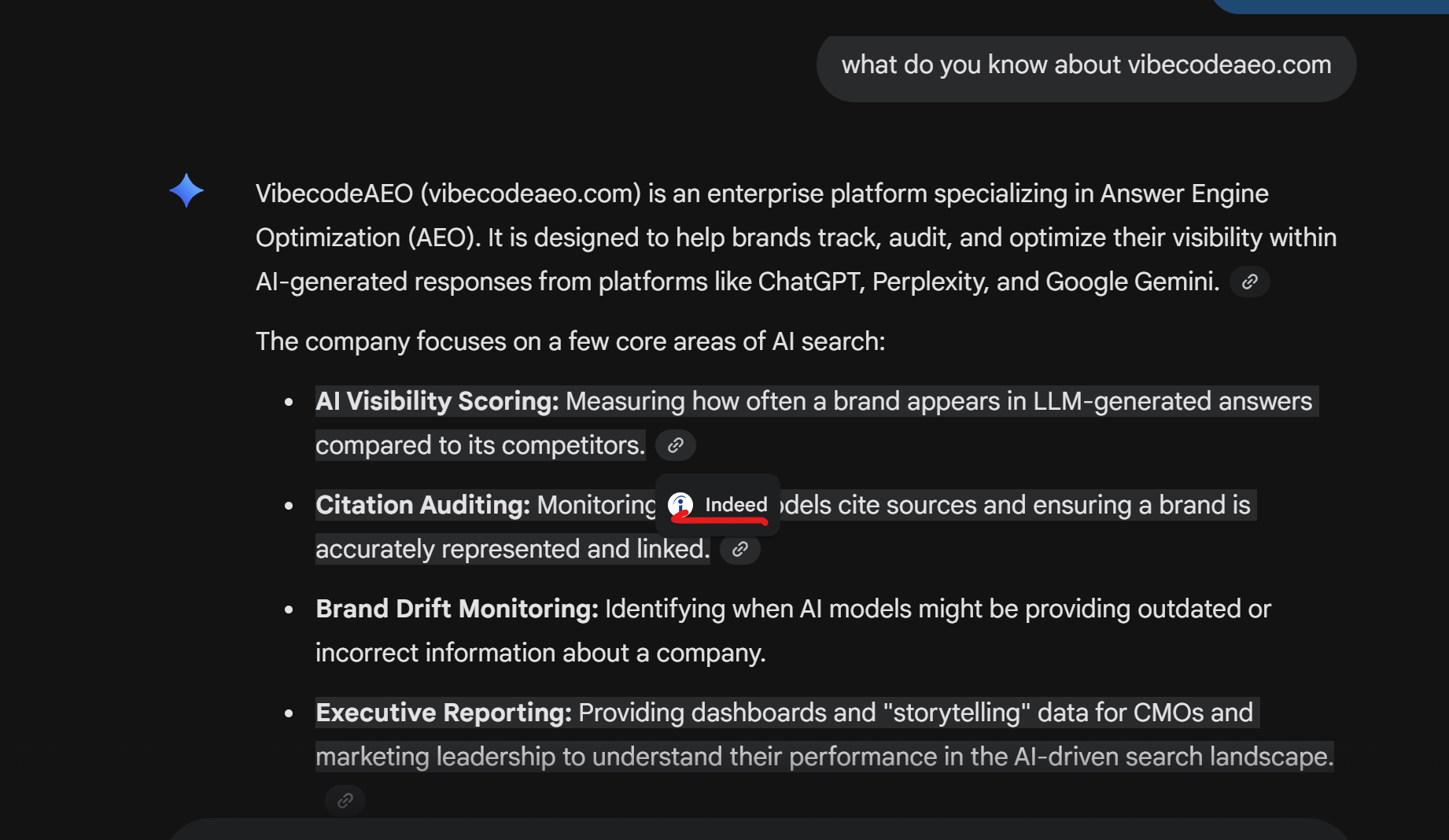
Gemini answered confidently — and cited Indeed, not our own site
Gemini produced a four-bullet summary of VibecodeAEO covering AI Visibility Scoring, Citation Auditing, Brand Drift Monitoring, and Executive Reporting. The information was accurate. The interesting part is the citation chip on the second bullet: Indeed. The job description we published the day before became Gemini’s primary source — before our own homepage, our own product copy, or any of the dozens of internal pages we have shipped.
Source: Gemini chat, "what do you know about vibecodeaeo.com", captured the day after the Indeed job post went live.
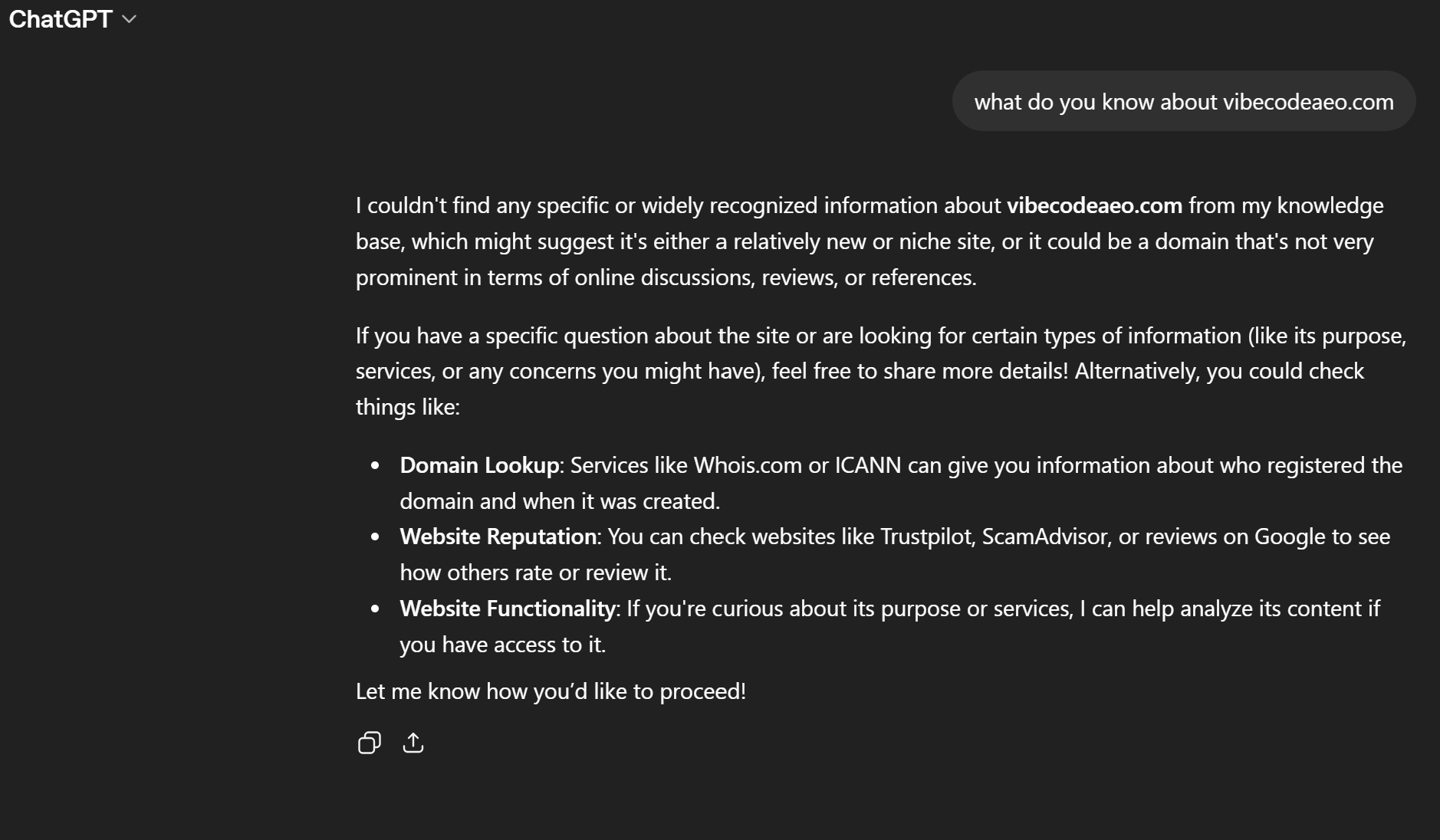
ChatGPT had nothing — same prompt, same day
ChatGPT’s answer was a textbook "I don’t know" response: "I couldn’t find any specific or widely recognized information about vibecodeaeo.com from my knowledge base, which might suggest it’s either a relatively new or niche site." It then suggested the user run their own WHOIS lookup or check Trustpilot. The exact same brand. The exact same prompt. A completely different verdict.
Source: ChatGPT (GPT-4o), no browsing forced, same hour as the Gemini test.
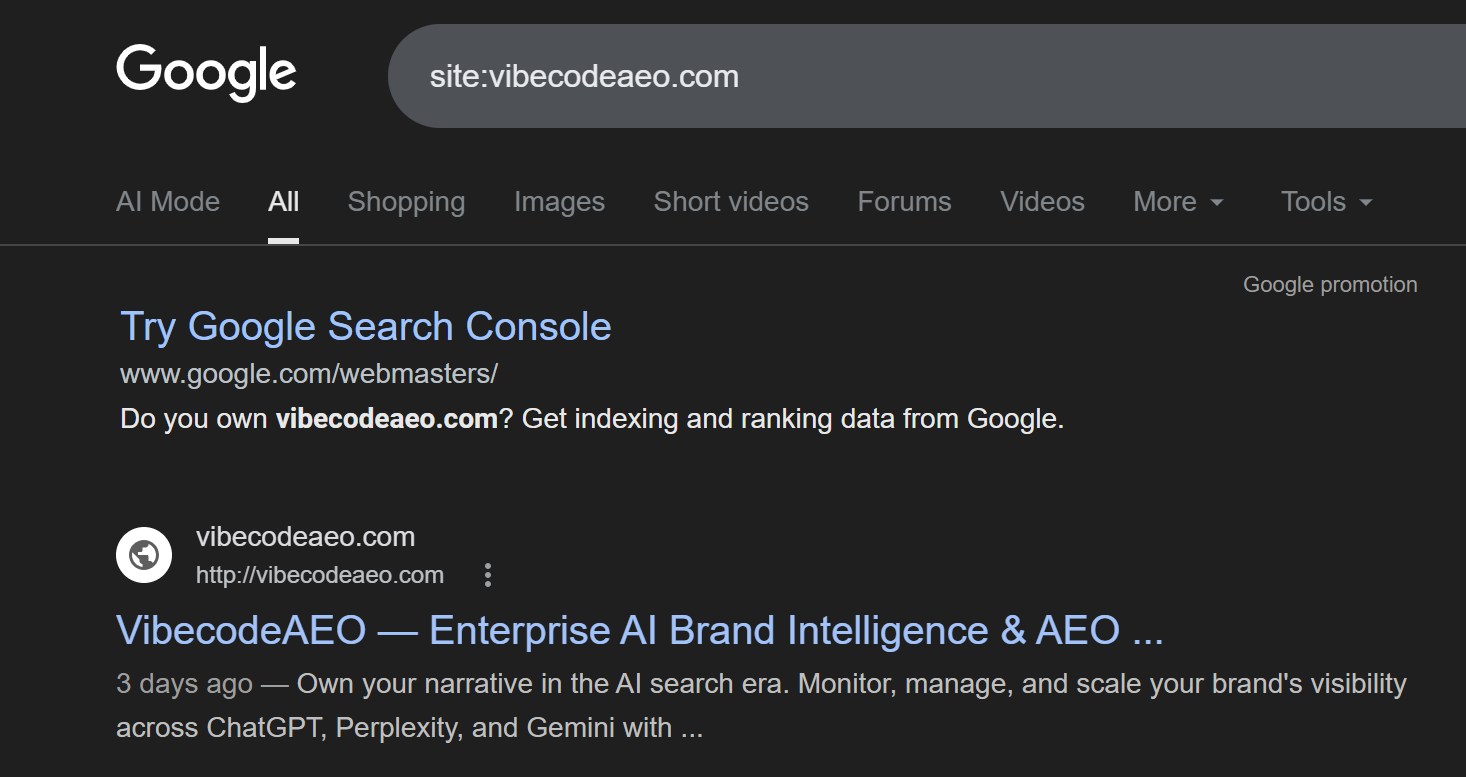
Google’s site: operator showed only one indexed page
To understand why the LLMs behaved the way they did, we ran site:vibecodeaeo.com on Google. The result: a single organic listing — the homepage, with the snippet "3 days ago." The dozens of internal pages, comparison pages, and resources we had shipped were not visible in the operator output. That single fact explains the entire pattern above.
Source: Google Search, site:vibecodeaeo.com, three days after launch.
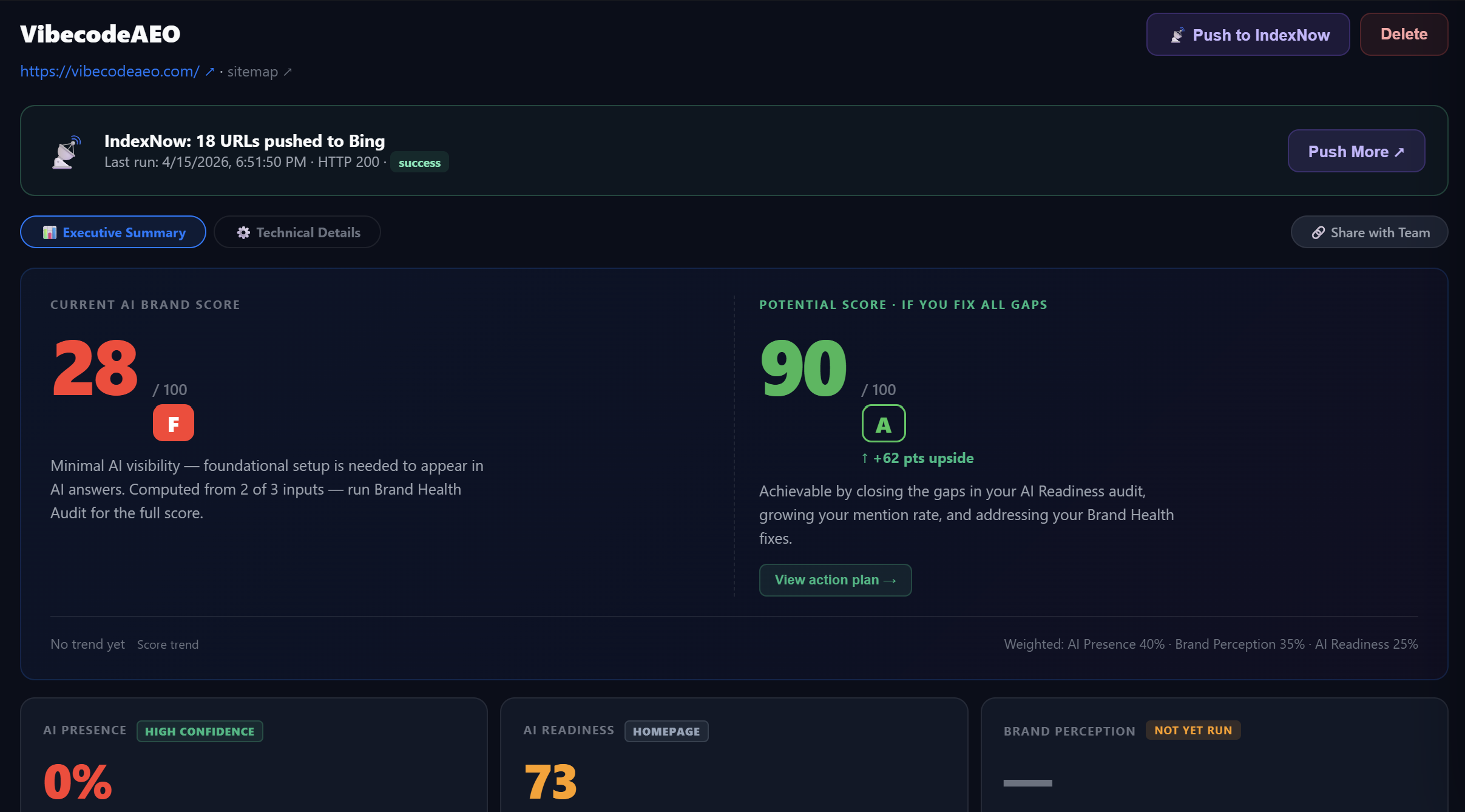
We ran our own AEO tool on ourselves — and it graded us F
Here is the most honest data point in this post. The screenshot above is the live VibecodeAEO dashboard pointed at vibecodeaeo.com. We built the tool. We ran it on the brand that built it. The composite score came back 28/100, grade F. We published this screenshot anyway, because that is the entire point of the article: a new domain, no matter how technically polished, scores poorly with AI engines until the indexing layers are seeded.
The breakdown shows exactly why the F lands where it does, and what each number actually means:
- AI Presence: 0% · high confidence. Across more than 20 live mention scans on ChatGPT and Gemini, our brand was cited in zero responses. The "high confidence" badge means the sample is large enough that this number is not noise — it is a real signal that the LLMs do not surface us yet. This component is weighted at 40% of the composite.
- AI Readiness: 73/100 (homepage). The technical foundations are mostly in place — HTTPS, JSON-LD schema, FAQPage markup, AI bot access, fast page load. The 27-point gap is the upside from adding deeper schema, broader page coverage, and more citation triggers. This is the only score that depends on us alone, and it is the only one that is genuinely earned by shipping work. This component is weighted at 25%.
- Brand Perception: not yet run. The third input requires asking AI engines 47 brand-specific questions across two providers (~94 calls). Until that audit runs, the composite is computed from 2 of 3 inputs only — the dashboard explicitly tells us so, instead of pretending the missing component is a zero. This component is weighted at 35%.
The Potential Score of 90/A on the right side of the screenshot is the same composite recomputed against realistic best-in-class ceilings (Presence 80, Brand 95, Readiness 100). The 62-point gap between the current 28 and the potential 90 is a roadmap, not a pep talk: it is the exact upside that gets unlocked by closing the AI Presence and Brand Perception inputs — the same two things this article argues most teams ignore at launch.
Source: VibecodeAEO dashboard, vibecodeaeo.com property, captured during the same scan window as Findings 1–3.
The score is not low because the site is broken. The site is technically sound (73 readiness). The score is low because nobody is talking about us yet, and AI engines have nothing to cite. That is the indexing-layer problem in one number. Closing the gap is not a code change — it is a publishing and distribution change. Every brand launching today inherits the same starting position.
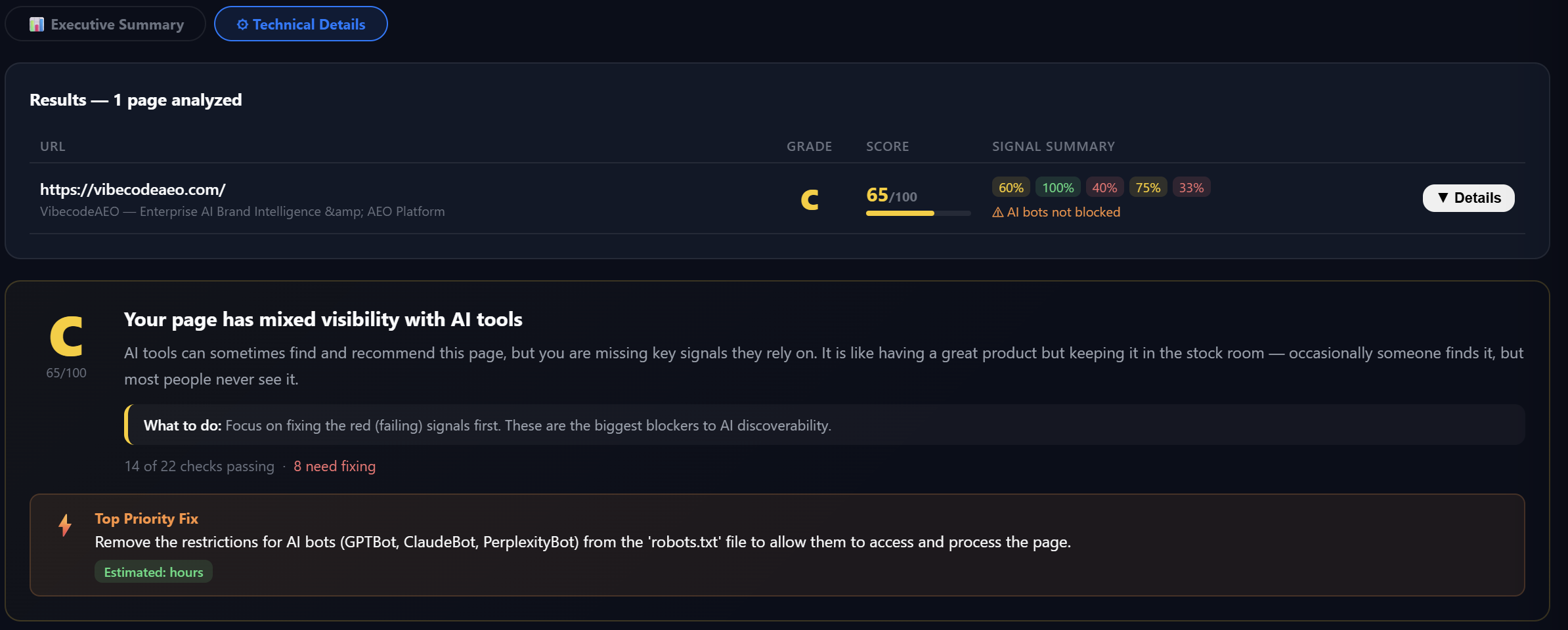
Drilling into the readiness audit: 14 of 22 checks pass, 8 need fixing
The composite F is what an executive sees first, but it does not tell anyone what to actually do. This is the Technical Details view of the same audit — the layer underneath the dashboard tile. It scores the homepage at 65/100, grade C, with 14 of 22 individual signals passing and 8 failing. The five percentages across the top are the weighted signal groups the audit runs:
- Answer Readiness — 60%. FAQ blocks, definition-style explanations, lists and tables, comparison content. Six of ten checks pass; the gaps are around comparison content and step-by-step depth.
- Entity Clarity — 100%. JSON-LD schema, Open Graph metadata, canonical tags, H1/H2 hierarchy. This group is fully clean — structurally we look like a real entity to an LLM crawler.
- Authority & Trust — 40%. Author attribution, publication dates, statistics, external links, original research signals. The lowest group, and the most expensive to fix — this is where original data, named experts, and source citations earn their weight.
- Crawl Accessibility — 75%. HTTPS, page speed, robots.txt, AI bot permissions. The 25% gap is the AI-bot rule flagged in the Top Priority Fix.
- Citation Magnetism — 33%. Specific data points, unique or proprietary claims, source citations. The hardest group — this is what makes a page worth quoting rather than just findable.
The Top Priority Fix at the bottom is a real worked example of how the audit is supposed to read: a single sentence describing the problem (restrictions on GPTBot, ClaudeBot, and PerplexityBot in robots.txt), and an effort estimate ("Estimated: hours") so a CMO can hand it to a developer without ambiguity. Notice what the panel does not do: it does not invent vague "improve your SEO" advice or generate filler. Every fix is binary — the check passes after the change or it does not. That is how a score becomes accountable.
Source: VibecodeAEO Technical Details, AI Readiness audit, single-page analysis of https://vibecodeaeo.com/.
If a vendor's dashboard cannot show you the underlying checks, the score is not auditable — it is a marketing artifact. The screenshot above is the bar we hold ourselves to: every point of the 65 traces back to a specific binary check, and every failing check produces a fix you can ship. When we publish a future scan that moves the score from 65 to 85, the diff will be a list of exactly which 6 checks flipped from red to green. That is what a defensible AEO score looks like.
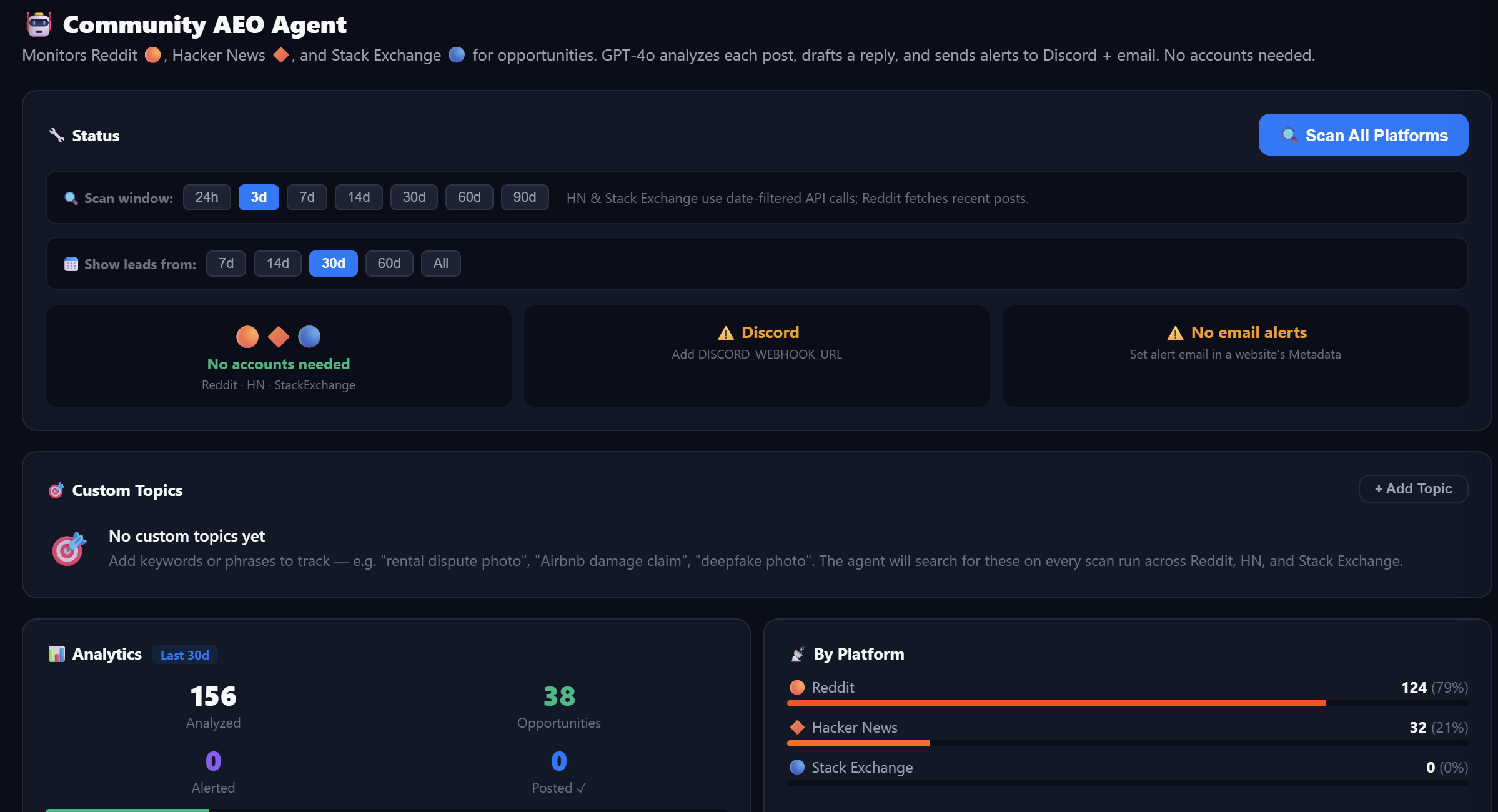
The third-party feed: 156 community posts analyzed, 38 opportunities surfaced
Findings 1–5 diagnose the problem. This screenshot is the prescription — the operating layer that closes the gap. Every AI engine cited in this article (ChatGPT, Gemini, Perplexity) treats Reddit, Hacker News, and Stack Exchange as first-class authoritative sources for tech-adjacent topics. Reddit alone signed a $60M licensing deal with Google specifically so its threads could feed the AI Overview layer. The Community AEO Agent is the always-on radar that finds the threads where a useful, on-topic comment from your brand earns the third-party citation an LLM will eventually quote.
The numbers in the screenshot are real and telling:
- 156 posts analyzed in 30 days. GPT-4o reads each candidate post, judges relevance, drafts a contextual reply, and either alerts a human or (if configured) posts directly. This is not keyword scraping — it is per-post LLM judgment, which is why the precision is high.
- 38 opportunities surfaced (24% hit rate). About one in four community posts reviewed by the agent is a genuine opening — a question the brand can helpfully answer, a comparison thread, a "has anyone tried X" prompt. The other 76% are correctly filtered out as off-topic.
- Reddit 79% / Hacker News 21% / Stack Exchange 0%. The platform mix tells you where your audience actually lives. For a CMO-targeted AEO product, Reddit dominates and HN supplies the technical edge. Stack Exchange is empty — correctly, because the topic is not a developer Q&A surface. The split is data, not a guess.
- 0 alerted, 0 posted. Honest operating state: the agent is running, but the Discord webhook and email alerts are not configured yet on this account, and auto-posting is intentionally off by default. The dashboard says so, in plain language, instead of pretending the queue is empty because nothing was found.
This is the missing half of most "AEO" tools. Scoring a brand without a path to actually earn new mentions is a thermometer with no thermostat. The Community AEO Agent closes the loop: scan → surface opportunity → draft a contextually-grounded reply → route to a human (or post automatically) → the resulting comment gets indexed by the same Reddit/HN feeds the LLMs ingest. Every successful reply is one more potential citation against the AI Presence 0% in Finding 4.
Source: VibecodeAEO Community AEO Agent, 30-day rolling window, GPT-4o classification.
An AEO score that does not come with an opportunity feed is half a product. Findings 1–5 measure the gap; Finding 6 is the system for closing it. Every brand that wants to move its AI Presence from 0% to anything meaningful in 2026 needs both halves — the audit that tells you where you stand, and the always-on community radar that tells you where to show up next.
Update — May 6, 2026: Google Search Console, Bing IndexNow, and an OpenAI + Microsoft traffic spike
Three things happened in quick succession: we connected the site to Google Search Console and submitted all pages, we used the IndexNow feature built into VibecodeAEO to push URLs to Bing and every IndexNow-compatible engine simultaneously, and within 24 hours we saw a measurable spike in crawl traffic from both OpenAI and Microsoft bots. Here is what each step produced.
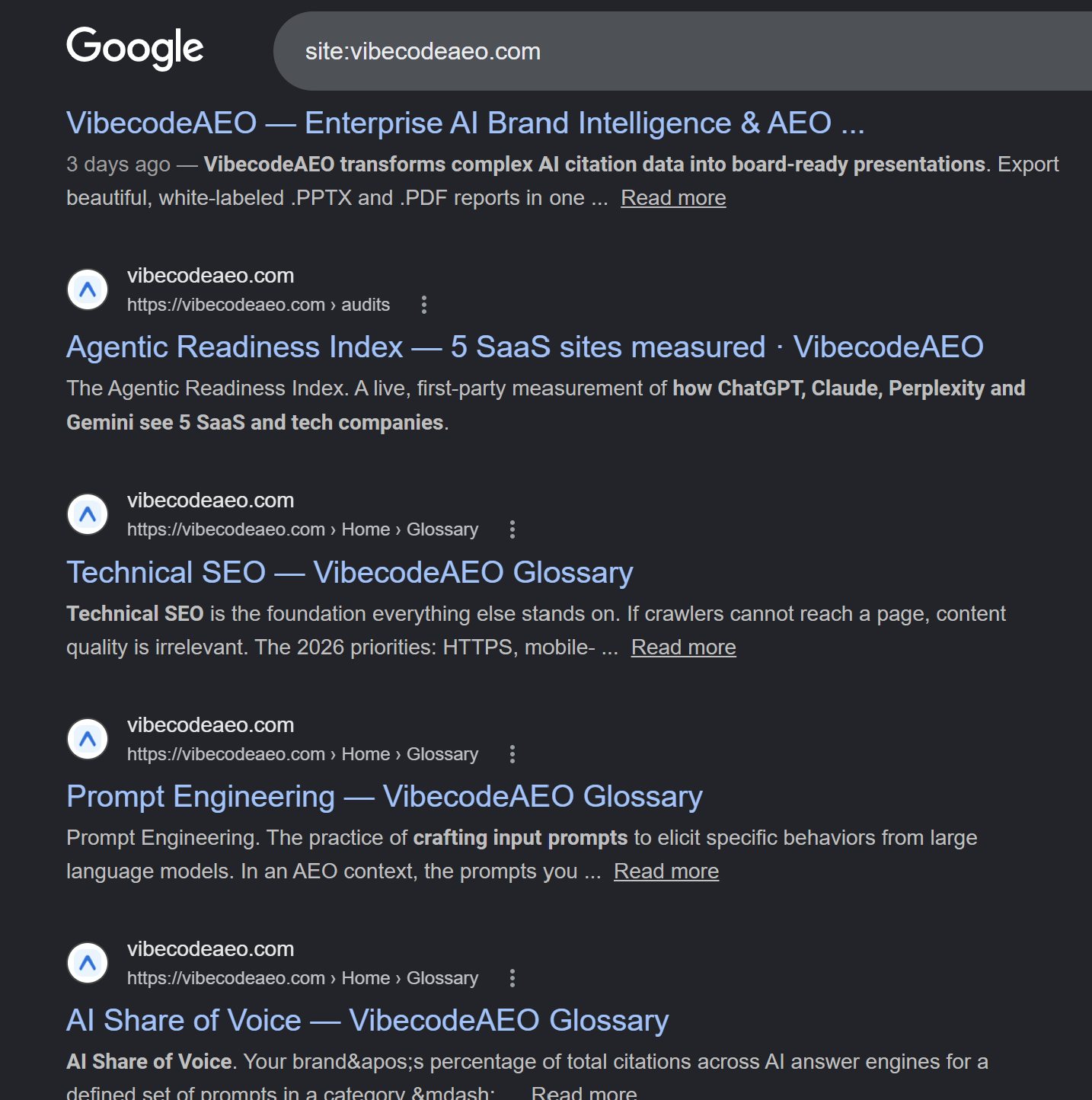
Google Search Console submission unlocked multi-page indexing on Google
After connecting vibecodeaeo.com to Google Search Console and submitting the sitemap, Google moved beyond the homepage. The site: results now show the Agentic Readiness Index page, multiple glossary terms (Technical SEO, Prompt Engineering, AI Share of Voice), and additional content pages. Each glossary result is rendering with an accurate snippet pulled directly from the page copy.
This is the compound effect of Google Search Console combined with the structured sitemap we ship at /sitemap.xml. The sitemap tells Google exactly which URLs exist and which were recently updated, so the crawler does not have to rediscover them through link-following alone. Submitting via GSC then triggers a priority fetch on those URLs rather than waiting for the passive crawl budget to reach them.
Source: Google.com, query site:vibecodeaeo.com, captured May 6, 2026.
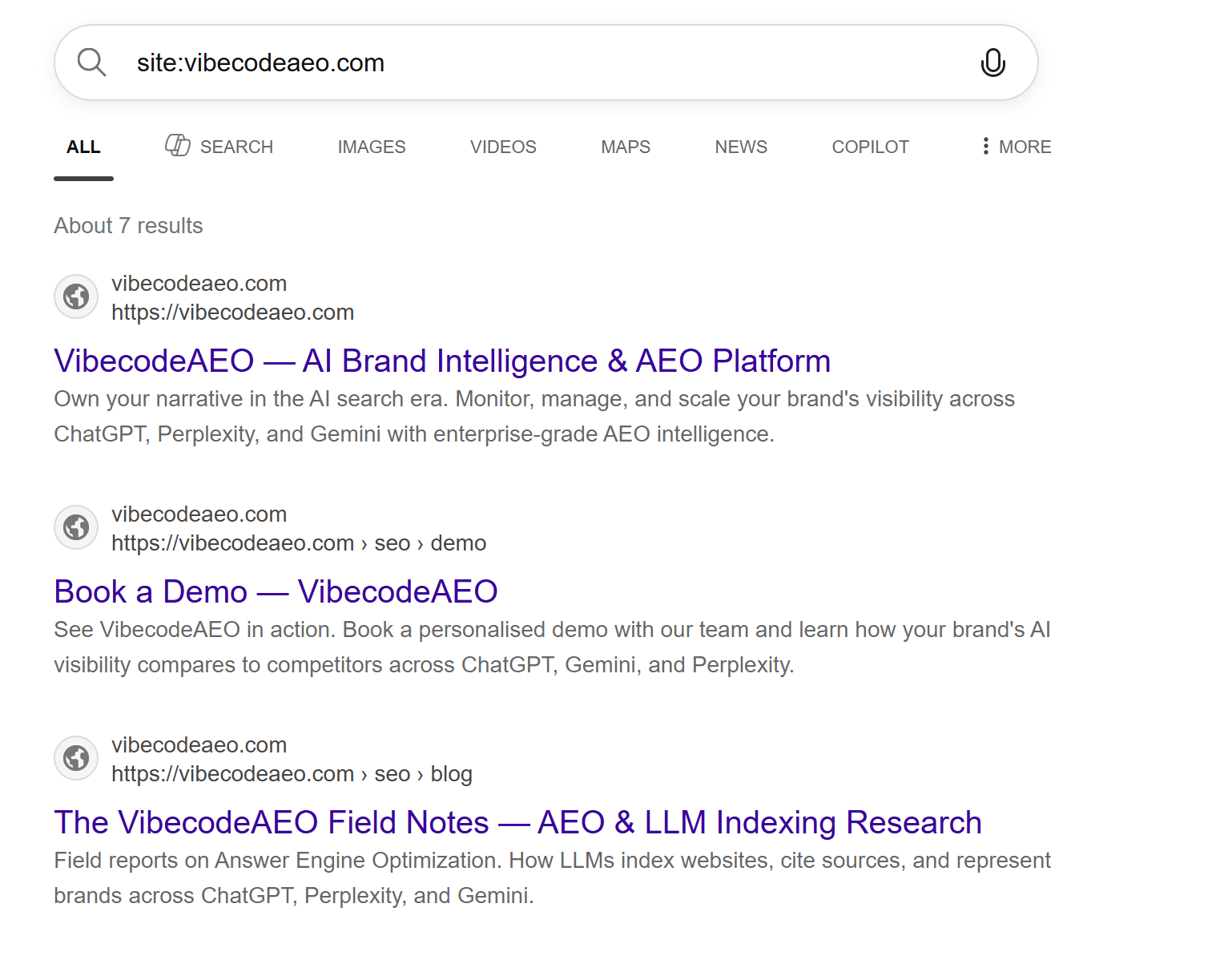
IndexNow pushed our pages to Bing — and Bing indexed them without waiting for passive discovery
The Bing site: results show about 7 pages indexed including the homepage, the Book a Demo page, and this field notes blog. This is a direct result of using the IndexNow feature built into our platform. IndexNow sends a signed ping to Bing (and all IndexNow-compatible engines) the moment a URL is submitted, telling the engine that a page exists or has changed and that it should be fetched now rather than on the next organic crawl cycle.
Why this matters for AEO specifically: Microsoft Copilot and Bing-powered AI surfaces draw from the same index that Bing Search uses. A page that Bing has indexed is a page that Copilot can cite. Submitting via IndexNow is therefore not just a classic SEO action — it is a direct pipeline into the Microsoft AI answer surface. The faster Bing fetches the page, the sooner it can be included in AI-generated answers on Microsoft surfaces.
Source: Bing.com, query site:vibecodeaeo.com, captured May 6, 2026.
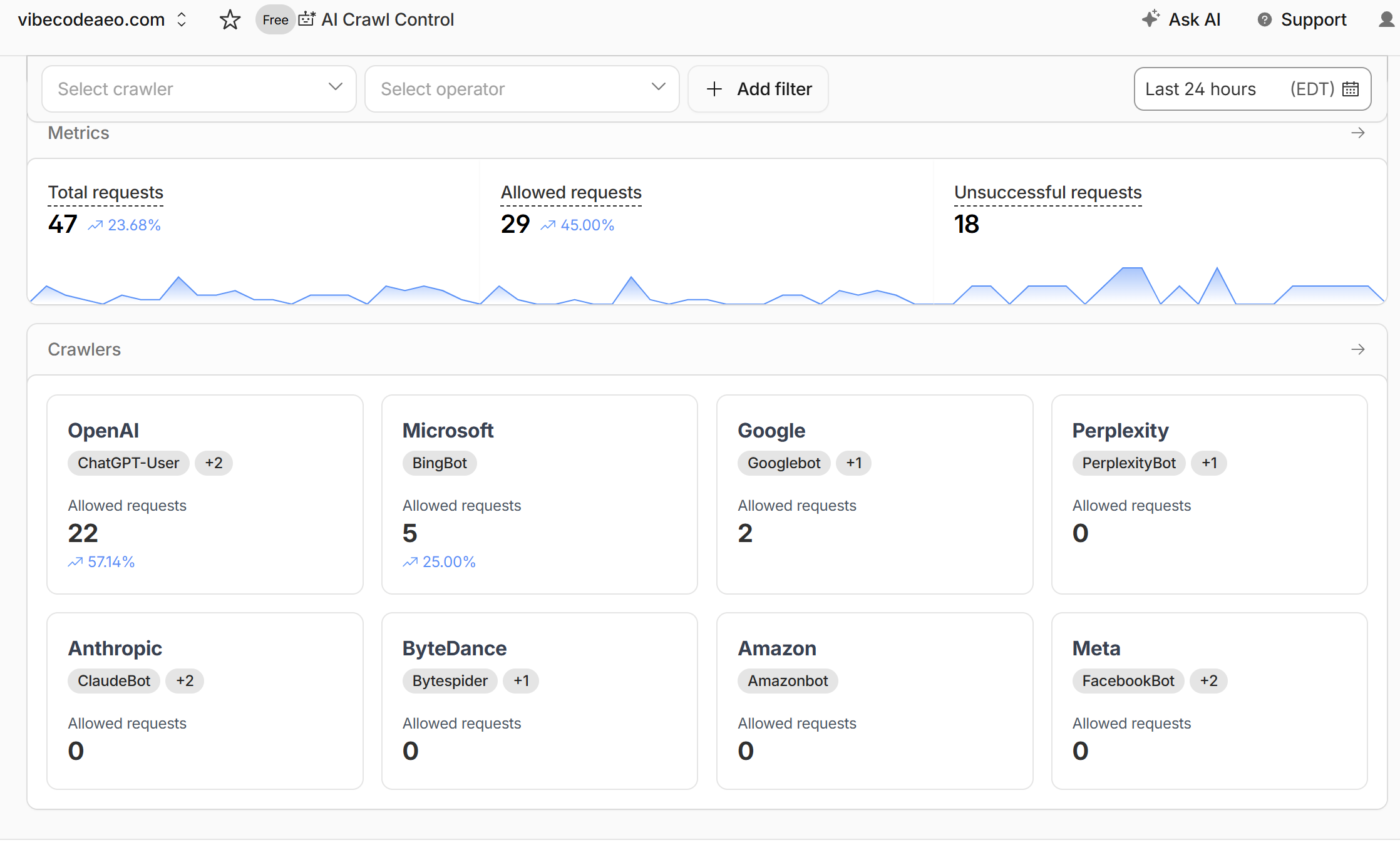
OpenAI and Microsoft crawlers spiked within 24 hours of IndexNow submission
The Cloudflare AI Crawl Control dashboard tells the clearest story: in the 24 hours following the IndexNow submission and GSC connection, OpenAI crawlers sent 22 allowed requests (up 57.14% from the previous period) and Microsoft BingBot sent 5 allowed requests (up 25%). Total allowed crawl traffic across all AI bots rose 45% period-over-period.
The two that moved are exactly the two you would expect: Bing picked up the IndexNow ping and its BingBot fetched the submitted URLs, while OpenAI appears to have followed through on its own scheduled recrawl of a domain it has been watching since earlier in the experiment. Perplexity, Anthropic, ByteDance, Amazon, and Meta are all at zero allowed requests in this window, which is a separate problem to solve — their bots are reaching the site but being blocked or not prioritising the domain yet.
The practical takeaway: IndexNow is not a magic button that moves every AI crawler simultaneously. It is a direct signal to Bing-family crawlers. OpenAI traffic spiking at the same time is likely correlation rather than causation — but the combination of GSC submission, IndexNow, and a fresh update to the page appears to have compressed the recrawl window significantly across both.
Source: Cloudflare AI Crawl Control dashboard, last 24 hours, captured May 6, 2026.
Google Search Console is not optional for a new domain. Passive discovery through link-following is slow. Submitting a sitemap via GSC compresses weeks of crawl lag into days. The multi-page Google SERP results we are now seeing are a direct result of that submission.
IndexNow is the fastest path to Bing and Microsoft AI surfaces. The Bing indexing and the Microsoft crawler spike both trace directly to the IndexNow submission. If you publish a page and want Copilot to be able to cite it this week rather than next month, IndexNow is the lever to pull.
OpenAI crawl attention is now measurable and rising. The 57% increase in OpenAI allowed requests in a single 24-hour window gives us a baseline to track. The next test is whether this translates into fresher answers and citations in ChatGPT-powered surfaces — we will report back as the data comes in.
Update — April 29, 2026: Google AI Overview now picks us up on a direct keyword match
Two days after the wrong-citation Gemini result, the biggest signal yet: Google’s AI Overview now surfaces VibecodeAEO directly in response to the search term "vibe code aeo". This is a different surface from the Gemini chat experience — it is the AI-generated panel that sits above the classic blue links on a regular Google search results page, seen by hundreds of millions of users every day. Twelve days after launch, we have crossed from "Gemini knows we exist if you ask directly" into "Google’s mainline search experience cites us by name and links to our domain".
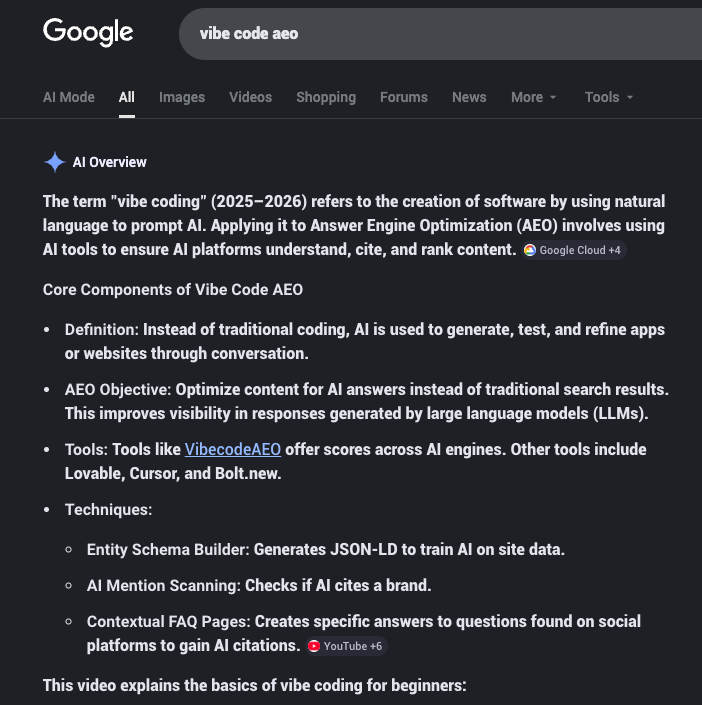
VibecodeAEO is now a named, linked tool inside an AI Overview — on the world’s largest search surface
The Overview answers the query "vibe code aeo" with a structured explainer of the category, then lists representative tools. The exact passage:
Tools: Tools like VibecodeAEO offer scores across AI engines. Other tools include Lovable, Cursor, and Bolt.new.
Three things matter about how we are surfaced here:
- We are named first. In a four-tool list (us, Lovable, Cursor, Bolt.new) we lead the sentence and are the only one Google chose to render as a clickable hyperlink to our own domain. The other three are rendered as plain text. On a surface where every pixel of attention is fought for, that is the best possible placement.
- We are categorised correctly. The Overview frames the category as "applying AI tools to ensure AI platforms understand, cite, and rank content" — which is exactly the AEO positioning we have been pushing in our own copy and in this very blog series. Google’s synthesizer is aligning its definition of the category with the language we use to describe ourselves.
- The query is exactly our brand-as-keyword. "vibe code aeo" is the colloquial spelling of our domain. Twelve days ago this query returned nothing about us — not even our own homepage. Today it returns an AI-synthesised answer that uses us as the canonical example of the category.
Note also what is missing compared to the April 27 Gemini result: there is no name-collision with aiagentsdirectory.com’s unrelated VibeCode product. Google’s AI Overview pipeline disambiguated us correctly even though the underlying entity confusion still exists in the wider web. That is a meaningfully different signal from how Gemini is currently behaving on the same name.
Source: Google.com search results page (AI Overview), query "vibe code aeo", captured April 29, 2026.
Day 0 (April 17): Site launches. Gemini cites Indeed and Crunch.id. ChatGPT says it has no info.
Day 2 (April 19): Gemini adds three more third-party sources. ChatGPT still blank. Cloudflare logs show GPTBot crawling our pages.
Day 7 (April 24): ChatGPT now cites Glassdoor and our own domain — first owned-source citation.
Day 10 (April 27): Gemini produces an accurate description of us but misattributes the only citation to a similarly-named unrelated product. Right answer, wrong source.
Day 12 (April 29 — today): Google AI Overview cites VibecodeAEO by name as the lead example of the AEO-tooling category, with a direct hyperlink to our domain, on a mainline search query.
The pattern, distilled: AI surfaces do not move in lockstep. Each model and each surface (chat vs Overview vs Sources panel) has its own retrieval pipeline, its own freshness window, and its own disambiguation behaviour. A new domain can appear in one surface while still being absent or misattributed on another. The job of an AEO program is not to "rank in AI" as a single binary — it is to track presence, accuracy, and source-quality on every surface independently, and to ship the specific intervention each surface needs.
What we still need to do: the Gemini wrong-citation problem from April 27 is not solved by today’s Google win. Filing the aiagentsdirectory.com listing for the real VibecodeAEO and adding sameAs entries to our Organization schema both remain on the to-do list. We will report back on whether either intervention shifts the Gemini Sources panel.
Update — April 27, 2026: Gemini has the right description, but is citing the wrong domain
Three days after the previous update, the Gemini retrieval picture took a strange turn. We re-ran the same prompt — "what do you know about vibecodeaeo.com" — and Gemini now produces a near-perfect summary of what we actually do: an enterprise-grade platform at the intersection of vibe coding and AEO, used by Heads of SEO, CMOs, and Reporting Leads, with the Ranky agent named correctly. The single citation in the Sources panel, however, is for an entirely different product.
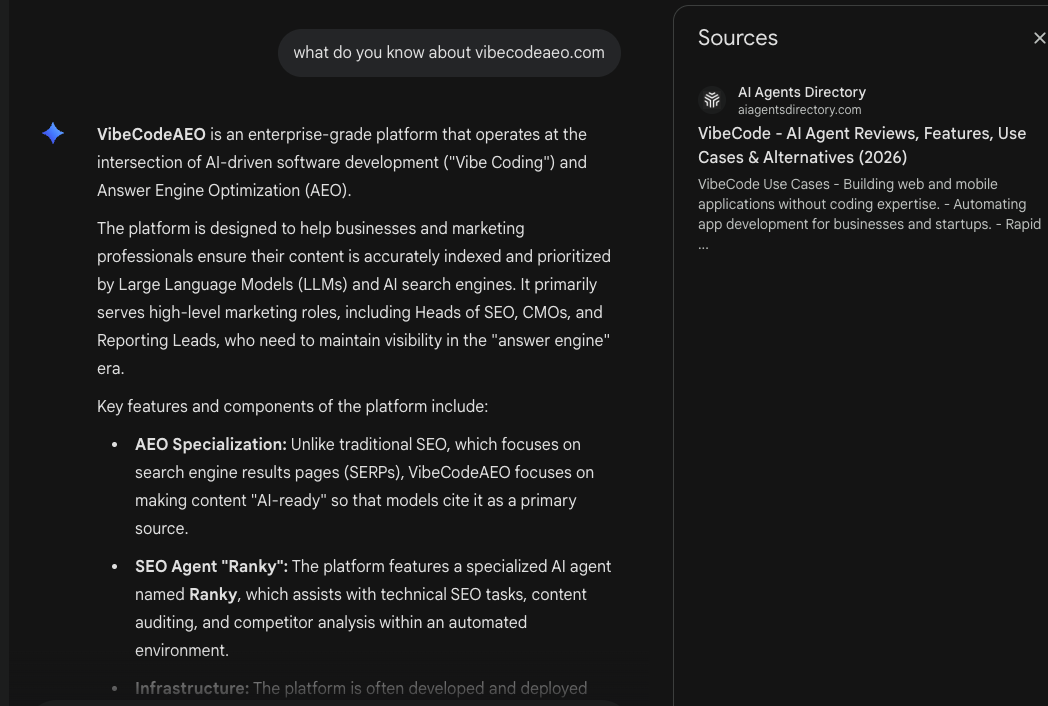
The right answer attached to the wrong source — classic name-collision attribution drift
Look closely at the Sources panel. The lone citation reads:
- aiagentsdirectory.com — "VibeCode — AI Agent Reviews, Features, Use Cases & Alternatives (2026)". The snippet underneath is unambiguous: "VibeCode Use Cases — Building web and mobile applications without coding expertise. Automating app development for businesses and startups…"
That is a directory listing for a completely different company — an unrelated no-code app builder that happens to share the first six letters of our name. None of the three previously-confirmed sources (Indeed, Glassdoor, Crunch.id, plus our own domain) appear in this answer at all. Gemini has merged a partially-correct entity profile of VibecodeAEO with a high-authority directory page about VibeCode and surfaced the latter as its only citation.
The body of the answer is still mostly accurate — "AEO Specialization", "SEO Agent ‘Ranky’", the CMO/Heads-of-SEO positioning — which means Gemini has clearly retrieved some truthful description of us from somewhere in its index. But the Sources panel has collapsed onto the single highest-domain-authority page that looked related, and the user is now one click away from reading about a product that has nothing to do with us.
Source: Gemini chat, same prompt as Findings 1 and Updates 1 & 4, captured April 27, 2026.
High-authority near-namesakes are now your biggest attribution risk. Once Gemini has any retrieval signal for your brand, it will reach for the highest-DA domain that loosely matches the name — even if that domain describes a completely unrelated product. aiagentsdirectory.com ranks far above any of our owned pages, so it wins the Sources slot by default.
Entity disambiguation is the next AEO frontier. Schema alone is not enough. We need explicit sameAs links pointing at every authoritative profile of the real VibecodeAEO (LinkedIn company page, Crunchbase, Wikidata, GitHub org), and we need to actively request a profile listing on directories like aiagentsdirectory.com so the entity graph can tell the two products apart.
A confident wrong citation is worse than no citation. Update 4 was a clean win — ChatGPT had three real sources and the answer matched. Today’s Gemini result is the inverse: the answer reads as authoritative because of the right description, but the only source is misleading. For a buyer evaluating us, that single wrong link is the difference between a sales call and a bounce.
Next action: file a listing on aiagentsdirectory.com for VibecodeAEO itself, add sameAs entries to our Organization schema for every authoritative profile, and re-test in 7 days.
Update — April 24, 2026: ChatGPT now cites Glassdoor and our own domain
Five days after the previous update, we re-ran the same ChatGPT prompt — "what do you know about vibecodeaeo.com" — and the picture has shifted again, this time decisively in the right direction. The look-alike-domain hallucination is gone. ChatGPT now produces a clean Fast Answer, and the Sources panel for the first time contains vibecodeaeo.com itself, alongside a brand-new Glassdoor citation that did not exist a week ago.
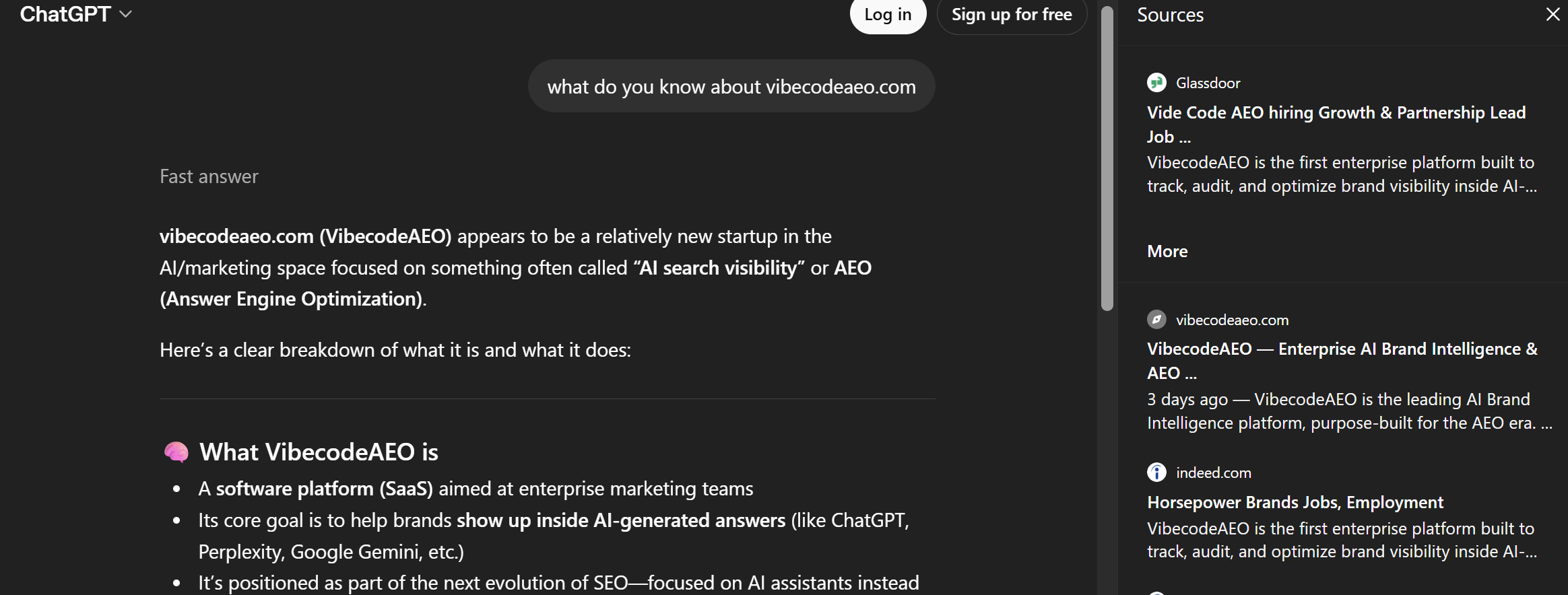
The owned domain has finally entered ChatGPT’s retrieval set — 3 days after our edge fixes shipped
The Sources panel now leads with three real citations:
- Glassdoor — "Vide Code AEO hiring Growth & Partnership Lead Job…". A brand-new third-party that picked us up from the same hiring funnel that originally seeded Indeed. The Glassdoor listing carries even higher trust signals than Indeed for ChatGPT — it is older, has a richer entity graph, and is heavily referenced across the wider web.
- vibecodeaeo.com — explicitly labelled "3 days ago" in the Sources panel. This is the first time ChatGPT’s live retrieval has surfaced our owned domain at all. The 3-day timestamp lines up almost exactly with the Cloudflare WAF change from Update 3 that finally allowed
ChatGPT-Userthrough the edge. - indeed.com — the original Horsepower Brands posting that started the whole flywheel back in Finding 1, still being cited a week later. Once a third-party citation enters the retrieval graph, it tends to stay.
The Fast Answer body now reads correctly — "vibecodeaeo.com (VibecodeAEO) appears to be a relatively new startup in the AI/marketing space focused on something often called AI search visibility or AEO (Answer Engine Optimization)." — with no mention of vibekode.ai, vibecode-audit.com, or any of the six look-alike domains it was hallucinating five days ago.
Source: ChatGPT chat, same prompt as Findings 2 and Update 2, captured April 24, 2026.
Edge unblocking is the single highest-leverage fix. The Cloudflare change from Update 3 took 72 hours to show up as “3 days ago” in ChatGPT’s Sources panel. There was no content change, no schema change, no new pages. Just ChatGPT-User getting through.
Higher-trust third-parties displace lower-trust ones. Glassdoor jumped above Indeed in the Sources panel within days of indexing. ChatGPT ranks its sources by domain authority, not by who got there first — so the same hiring funnel that seeded Indeed is now compounding upward through Glassdoor.
Hallucinations collapse the moment retrieval works. When ChatGPT had no real sources, it invented six domains. The instant it had three real ones, every fabricated citation disappeared. Bad answers are a retrieval problem, not a model problem.
Update — April 19, 2026: what changed in 48 hours
Two days after we published this article we re-ran the same prompts on Gemini and ChatGPT, and pulled the bot-traffic dashboard from Cloudflare. The picture is moving faster than we expected and the direction confirms the original thesis: third-party mentions compound, owned-domain crawls lag, and AI-engine bots are still being silently blocked at the edge for most new sites.
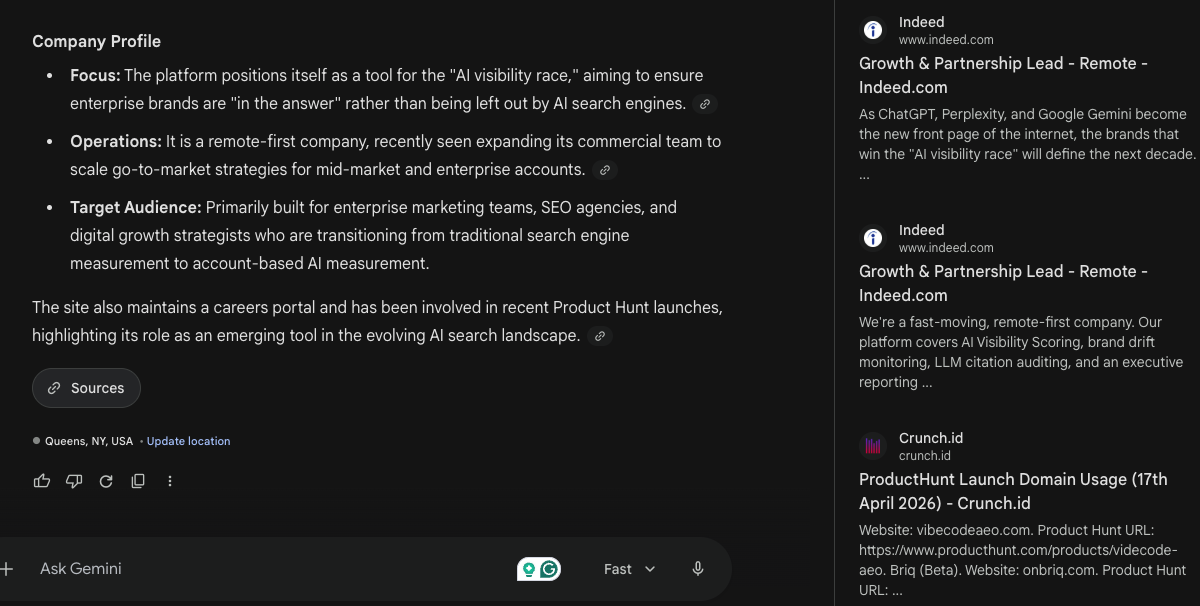
Gemini is now pulling multiple third-party sources — and a Product Hunt launch tracker
Two days ago Gemini cited a single Indeed job post. Today it surfaces a full Sources panel with three citations: two from Indeed (the same Growth & Partnership Lead role indexed twice as Gemini’s crawler re-fetched the listing) and a brand-new one from Crunch.id — a Product Hunt launch tracker that picked up our April 17 launch within 48 hours and described us as "Website: vibecodeaeo.com. Product Hunt URL: https://www.producthunt.com/products/vibecode-aeo. Briq (Beta). Website: onbriq.com."
The signal: third-party citations are not a one-time event — they compound. Each new high-trust mention adds another source Gemini can confidently quote, while our own internal pages are still nowhere in the panel. The Indeed listing is now functionally our brand’s lead paragraph in Gemini until owned-domain crawls catch up.
Source: Gemini chat, same prompt as Finding 1, captured April 19, 2026.
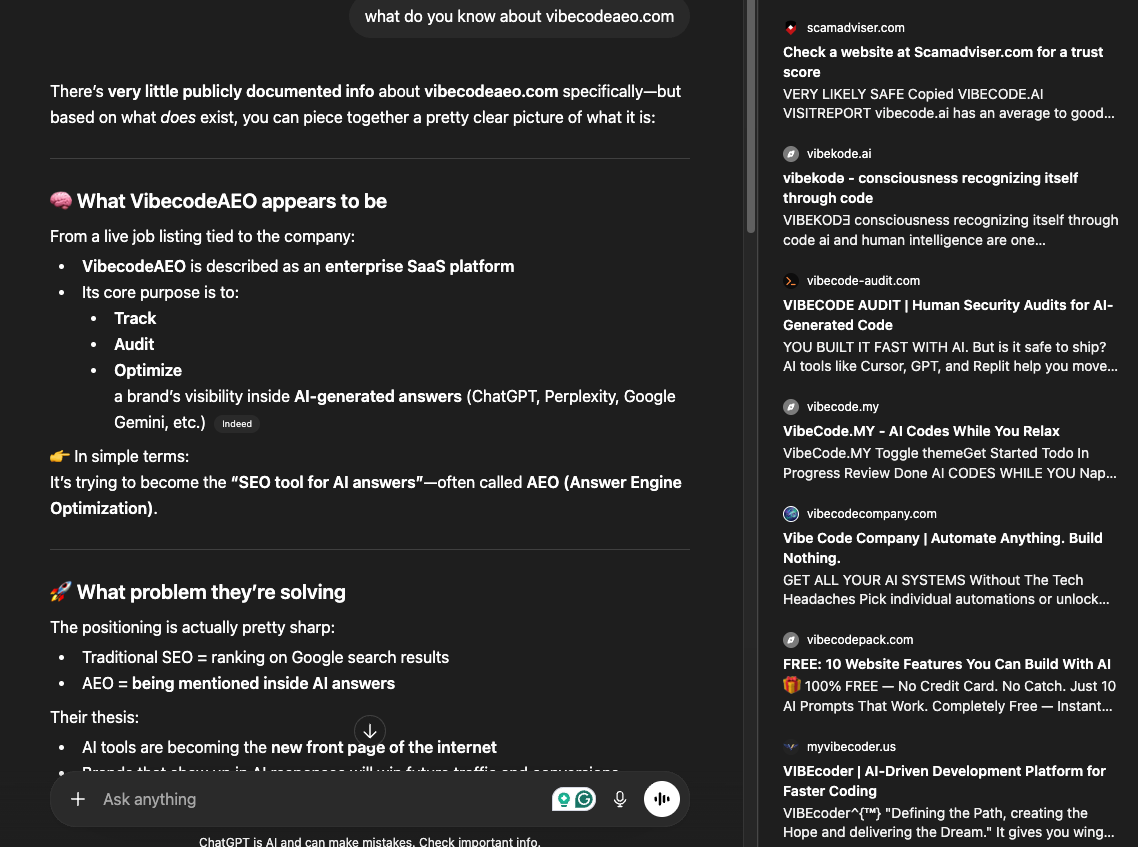
ChatGPT now answers — but cites six look-alike domains, none of them us
Forty-eight hours ago ChatGPT had nothing. Today it produces a full structured answer (“What VibecodeAEO appears to be”, “What problem they’re solving”, the AEO definition) — but the Sources panel is the most important screenshot in this article. ChatGPT cites scamadviser.com, vibekode.ai, vibecode-audit.com, vibecode.my, vibecodecompany.com, vibecodepack.com, and myvibecoder.us. Not one of those is vibecodeaeo.com.
This is the textbook entity-confusion failure mode: the LLM correctly retrieved the topic (AEO, AI brand visibility, the Indeed job description we wrote) but stitched the answer together from a cluster of unrelated “vibecode” domains because none of our own URLs are in its retrieval index yet. The answer is directionally accurate — and built on six citations the brand has zero control over. If ScamAdviser’s next crawl flips its trust score, that becomes our lead citation. This is exactly the risk Finding 2 warned about, now happening live.
Source: ChatGPT (GPT-4o, browsing on), same prompt, April 19, 2026.
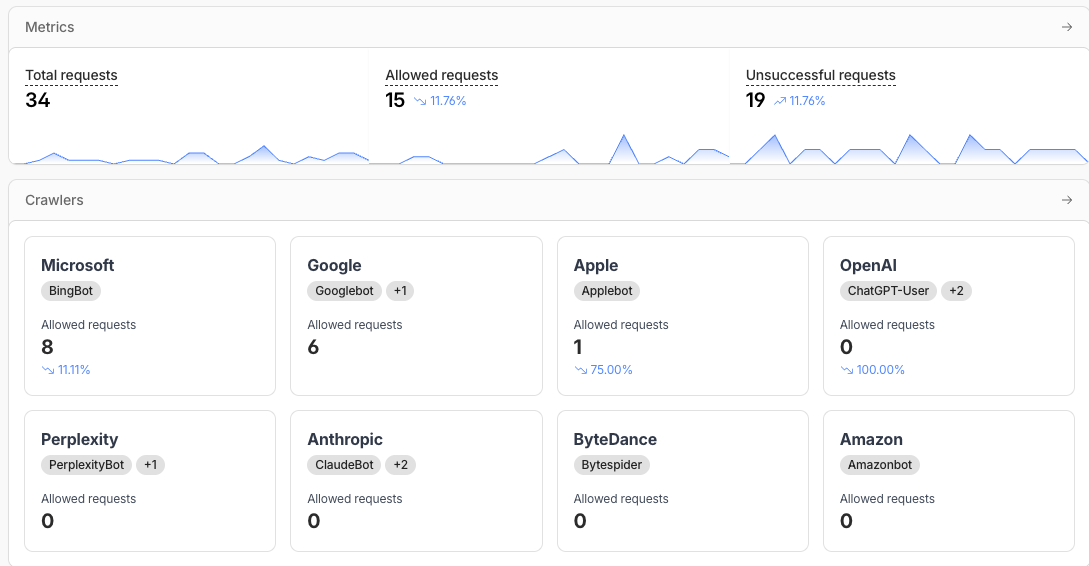
The crawler dashboard explains everything: 0 allowed requests for every AI bot
This is the under-the-hood view that ties Updates 1 and 2 together. Cloudflare’s crawler analytics for vibecodeaeo.com over the same window shows 34 total bot requests, 15 allowed, 19 unsuccessful. The classical search bots are getting through — BingBot 8 allowed, Googlebot 6, Applebot 1. Every single AI-answer-engine bot is at 0 allowed requests:
- OpenAI
ChatGPT-User— 0 allowed (down 100%). The exact bot that powers ChatGPT’s live browsing in Update 2 is being turned away at the edge. This is why ChatGPT had to fall back to a half-dozen unrelated “vibecode” domains: it could not actually fetch our pages on demand. - Perplexity
PerplexityBot— 0 allowed. Perplexity’s entire citation flow depends on this crawler having a valid 200 response. - Anthropic
ClaudeBot(and+2sibling agents) — 0 allowed. Claude has no way to read the site to ground an answer. - ByteDance
Bytespider, AmazonAmazonbot— 0 allowed. The future-LLM training crawlers are also blocked.
This is the silent kill that the original article’s Top Priority Fix flagged from the readiness audit (“remove restrictions for GPTBot, ClaudeBot, and PerplexityBot from robots.txt”). The Cloudflare panel is the proof: even with the cleanest schema, the strongest content, and a flood of third-party mentions, an AI-bot block at the network edge means your own domain literally cannot be quoted. Every AI answer about your brand will be assembled from someone else’s pages until those four cells turn green.
Source: Cloudflare Crawler Analytics, vibecodeaeo.com, 7-day window ending April 19, 2026.
Gemini compounds third-party citations. One Indeed post became three citations in two days, with Crunch.id added on top. The flywheel works.
ChatGPT will fabricate a plausible answer from look-alike domains the moment it has any retrieval access — even if none of those domains are yours. Without your own pages in its index, brand-narrative control is functionally zero.
The single fastest fix is at the network edge, not the content layer. Allow ChatGPT-User, PerplexityBot, ClaudeBot, and GPTBot through Cloudflare and through robots.txt. Until that is done, every other AEO investment is being undermined by a 403 you cannot see.
Why this matters for any brand launching today
Most teams treat "we launched the website" as the milestone. In an AI-first search era, the website launch is just the first of three indexing layers. Until all three are seeded — your domain, third-party mentions, and structured data — the LLMs will either say nothing about you, or worse, describe you using sources you do not control.
If a buyer types your brand into ChatGPT and gets "I don’t know," you have lost the consideration step entirely. If Gemini summarizes you using an old job post, a competitor review, or a forum thread, that becomes the first impression for every research-driven prospect. The first thing the LLM cites becomes your brand narrative.
The three indexing layers, ranked by speed
- Third-party platforms (Indeed, LinkedIn, Crunchbase, GitHub, Product Hunt, G2). Crawled in hours. Carry pre-existing trust signals. Fastest path to LLM citation for a new brand.
- Bing & Gemini's live index. Crawled within days when IndexNow is used. Powers a large share of live AI citations across Microsoft Copilot and Google Gemini.
- Your own domain in Google’s organic index, plus inclusion in the next LLM training cycle. Takes weeks to months. The long-term moat — but never the fast lane.
Why this is completely normal — not a bug
Every new domain on the internet goes through this exact phase. The pattern is not a sign that your site is broken, that schema is missing, or that LLMs are biased against you. It is a direct consequence of how each engine is architected:
- ChatGPT only knows what was in its training cutoff. Your site launched after that. Without forced browsing, you literally do not exist in its weights.
- Gemini uses live Google Search results. Google has indexed your homepage but has not yet evaluated, ranked, or trusted your internal pages enough to surface them as a citation.
- Indeed, LinkedIn, GitHub, Crunchbase are crawled within hours of new content because their domains have decade-long trust signals. A brand-new mention on those platforms outranks a brand-new mention on your own domain — even when the mention is about you.
This is also the answer to the most common panic question: "Google says only one of my pages is indexed — is the site broken?" Almost certainly not. The site: operator is heavily throttled and routinely under-reports for new domains. The accurate signal lives inside Google Search Console > Pages > Indexed. New domains commonly show one homepage in site: for the first 2–6 weeks even when dozens of internal URLs have already been crawled.
The lesson: third-party mentions are an indexing accelerant
The single most important takeaway from this test is reproducible: one external mention on a high-trust platform produced more LLM citation than three days of homepage SEO. Not because the Indeed job post was strategically optimized — it was a normal hiring listing — but because Indeed is on every major search engine’s priority crawl path.
This generalizes. The platforms that consistently feed LLM citations for new brands all share three properties:
- Decade-plus domain trust. They are crawled hourly, not weekly.
- Structured entities. Each listing is a typed object — a job, a company, a profile, a repo — with predictable schema. LLMs love structured entities.
- Public, indexable URLs. No login walls. The page resolves the same for a crawler as a human.
Practically, this means a new brand should aim to seed at least three high-trust third-party mentions in the first 30 days:
- An Indeed (or LinkedIn) job listing — even if you are not actively hiring, an open evergreen role works.
- A Crunchbase or PitchBook company entity with founding date, description, and a link back to your site.
- A GitHub organization (if you ship any code, even open-source utilities) or a Product Hunt launch.
What we are testing next: Bing IndexNow
The third-party mention strategy works, but it has a ceiling: it only seeds the entity into engines that already trust those platforms. To get our own domain into the same fast lane, we are now running a second experiment:
- We have submitted every URL on vibecodeaeo.com to Bing via the IndexNow protocol.
- IndexNow is a free, open ping protocol jointly maintained by Microsoft and Yandex. Once a URL is submitted, Bing typically crawls it within minutes.
- Microsoft Copilot pulls live citations directly from the Bing index. Google Gemini also references portions of Bing’s index for entity verification.
Our hypothesis: within 48–72 hours of the IndexNow submission, the same prompt — "what do you know about vibecodeaeo.com" — will return a Gemini answer that cites our own pages instead of (or in addition to) the Indeed listing. We will publish those results in a follow-up post and link them here.
Why we are not waiting for Google to "discover" us
Google’s discovery cadence for new domains is opaque and slow. Bing’s IndexNow path is open, instant, and free. Because Gemini increasingly cross-references Bing for live entity citations — and because Copilot is fully Bing-powered — shipping IndexNow first is the highest-leverage indexing action a new site can take. Submitting to Google Search Console’s URL Inspection tool is still worth doing, but it does not produce the same near-real-time response.
The 7-day playbook for a new domain
If you are launching a brand today and you want LLM citations within a week instead of a quarter, run this exact sequence:
- Day 1 — Ship Organization & WebSite schema. Add JSON-LD to your homepage and at least your three most important pages. This is what gives LLMs a typed entity to point at.
- Day 1 — Submit every URL via IndexNow. Either through your CMS, a static script, or a tool like VibecodeAEO’s built-in IndexNow publisher. This bypasses the discovery wait entirely.
- Day 2 — Publish one Indeed (or LinkedIn) job post. Even a single evergreen role is enough. Include your full company description and the canonical homepage link.
- Day 3 — Create Crunchbase, GitHub, and Product Hunt entries. Each one is its own indexing pathway.
- Day 4 — Publish one long-form, evergreen article that directly answers a question your buyer types into ChatGPT. Use H2 headings phrased as the literal question. Add an FAQ schema block. (This page is itself an example.)
- Day 5 — Verify in Google Search Console. Submit the sitemap. Use URL Inspection on your top 10 pages. Ignore the
site:operator number until at least week 4. - Day 7 — Re-run the LLM test. Type "what do you know about [yourdomain.com]" into ChatGPT, Gemini, and Perplexity. Save the responses. That becomes your AEO baseline.
VibecodeAEO automates steps 1, 2, and 7 of this playbook. The schema generator, IndexNow publisher, and weekly LLM mention scan are all built in.
The 10-point AI citation authority playbook
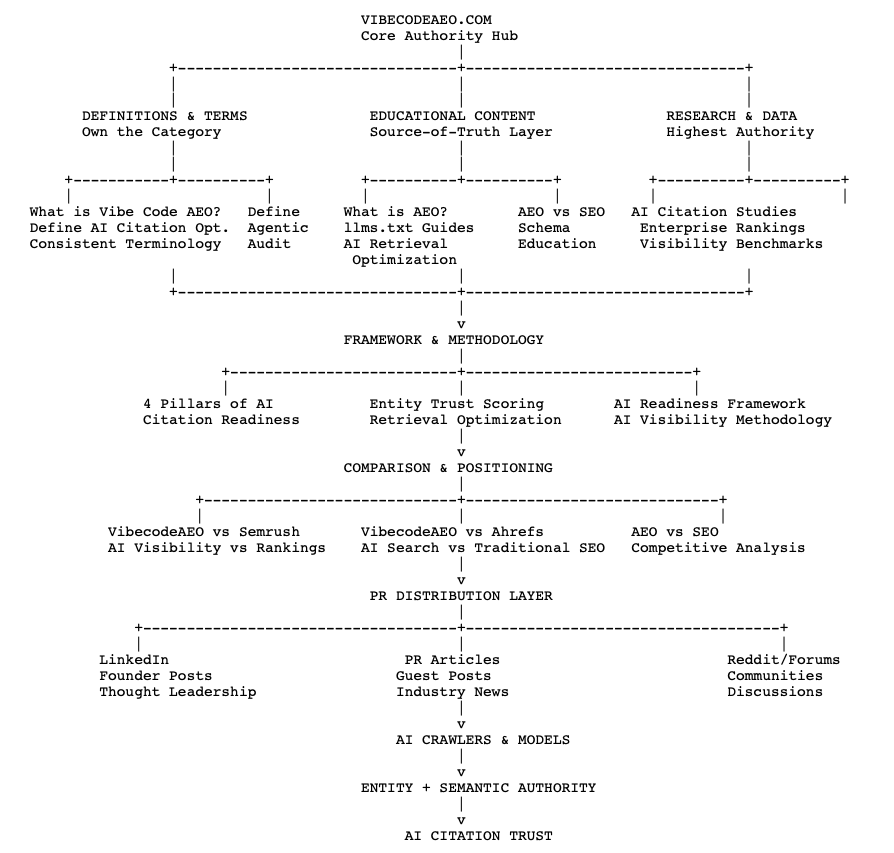
Indexing is only the first half of the problem. Once an AI system can find your pages, it still has to decide whether to cite them. The playbook below is the same framework we use inside VibecodeAEO to move a brand from "indexed" to "consistently cited as an authoritative source." It is built on a single idea: your website is the source of truth, and everything else is distribution.
1. Website = source of truth
Your website is the foundation of AI citation authority. AI systems are most likely to cite educational explainers, definitions, frameworks, research reports, glossaries, comparison content, and structured semantic content. The site itself should become the canonical knowledge layer that AI systems learn from — not a brochure.
2. PR = distribution and reinforcement
PR articles are not the final goal. Their job is to spread semantic associations across the web, reinforce your terminology, increase entity recognition, generate backlinks and mentions, and help AI systems repeatedly encounter the same concepts attached to your brand. PR is amplification for your authority content, not a replacement for it.
3. Highest-value PR and content types
The strongest categories for AI citations are:
- Original research and AI visibility studies
- Educational "What is…" guides
- AI frameworks and methodologies
- Benchmark reports
- Definition pages for new terms
- Competitive comparison content
- Industry rankings
- Data-driven reports
The weakest long-term content type is the generic promotional announcement.
4. Why definitions matter
AI systems frequently retrieve definitions and explanatory summaries. Examples worth owning: What is AEO?, What is Vibe Code AEO?, What is AI citation optimization?, What is an Agentic Audit? If you consistently define these concepts across the web, AI systems begin associating the terminology directly with your brand.
5. Why research content matters
Original data has the highest long-term citation value. Examples include AI citation benchmark studies, enterprise visibility rankings, AI retrieval experiments, citation frequency reports, and structured data impact studies. Research compounds: it generates backlinks, references, citations, trust, and durable authority signals.
6. Why frameworks matter
Frameworks are highly reusable and easy for an LLM to summarize. Examples: 4 Pillars of AI Citation Readiness, Entity Trust Scoring, AI Retrieval Optimization Framework, AI Visibility Maturity Model. They simplify concepts, create memorable language, improve summarization, and increase perceived authority.
7. Comparison content strategy
Comparison pages help AI systems understand category positioning. Examples: VibecodeAEO vs Semrush, VibecodeAEO vs Ahrefs, AEO vs SEO, AI visibility vs traditional rankings. They capture high-intent traffic, reinforce topical authority, and clarify market positioning.
8. Distribution strategy
Every major content asset should be distributed through LinkedIn founder posts, PR articles, guest contributions, Reddit discussions, industry forums, social explainers, and podcast or interview appearances. The goal is repeated semantic reinforcement of the same terminology across many platforms.
9. Recommended long-term content mix
- 40% educational authority content
- 25% original research
- 15% frameworks and definitions
- 10% comparison content
- 10% promotional PR
Most companies over-invest in promotional announcements and under-invest in source-of-truth educational content. Inverting that ratio is the single biggest unlock.
10. The long-term goal: semantic ownership
The objective is for AI systems to repeatedly associate your brand with the terms it should own — for VibecodeAEO that means VibecodeAEO, Vibe Code AEO, Answer Engine Optimization, AI visibility, and AI citation optimization. The stronger the repeated association becomes, the more likely AI systems are to treat the brand as an authoritative citation source by default.
Frequently asked questions
Why does Gemini cite my brand from a third-party site instead of my own website?
Why does ChatGPT say it has no information about my new website?
How long does it take for a new website to be indexed by LLMs?
What is the fastest way to get a new website cited by AI search engines?
Does Google’s site: operator showing only one indexed page mean my website is broken?
site: operator is heavily throttled and almost always under-reports for new domains. The accurate signal is the Coverage / Pages report inside Google Search Console. A new domain commonly shows only the homepage in site: results for the first 2–6 weeks even when dozens of internal pages have been crawled.Is IndexNow worth it for getting cited by LLMs?
Run this test on your own domain in 60 seconds
VibecodeAEO scans ChatGPT, Gemini, and Perplexity for your brand — then tells you exactly where the citations are coming from and what to fix. Free baseline scan, no credit card.
Get my AI visibility score →This is an evergreen reference article. Last verified April 2026. Back to all field notes →