#The short answer
All positions 1–15 are included. Positions 1–5 are truncated captures; positions 6–15 are complete responses. The five partial responses are shown exactly as saved and clearly labelled. Their missing text is unknown—not reconstructed. All 15 came from the same conversation, so earlier context may have influenced later answers.
Read the evidence in context: Each prompt below is immediately followed by all its saved ChatGPT response text, then our interpretation or analysis. For positions 1–5, that saved text is only a partial capture. Responses were captured on September 6, 2026; the separately selected page audits were run on September 13. We have preserved the response text rather than substituting a summary. Saved text is not a screenshot of the original interface, and it does not establish current pricing, product facts, verified citations, or sponsorship.
One captured ChatGPT conversation changed its recommendation when the decision changed. In positions 6–10, CRM answers treated the product as a customer system: HubSpot led the growing-brand, small-business, and startup prompts, while Zoho CRM led the remote-team and value prompts. In positions 11–15, email answers treated the product as a channel or lifecycle system: Klaviyo led the growing-brand prompt, Brevo led the small-business and value prompts, and HubSpot led the startup and remote-team prompts.
That is an observation about one conversation, not a market ranking. The records show how the answers framed five CRM jobs and five email jobs. They do not show that a platform is objectively best, that prompt wording caused a position, or that a recommendation was independently verified.
Vendor-authorship disclosure: VibecodeAEO produced this research and the page-readiness audit. The audit demonstrates our own product surfaces; it is not independent vendor certification or a neutral buying guide. The public pages audited below were selected independently because their brands recurred in the captured tables. They are not recovered citations from the answers.
#Five takeaways
- The decision criterion moved with the prompt. CRM answers emphasized customer records, handoffs, adoption, migration, and organizational complexity. Email answers emphasized ecommerce behavior, automation, newsletters, permissions, and scaling economics.
- HubSpot was the recurring default in this thread. It appeared in every CRM and email shortlist, but the repeated recommendation may also reflect the business context carried through one conversation.
- Specialists appeared when the job became specific. Pipedrive was associated with sales execution, Zoho with value or distributed collaboration, Klaviyo and Omnisend with ecommerce, Brevo with value, and ActiveCampaign or Customer.io with deeper automation.
- The answer tables are not independent evidence. There was one conversation, no saved destination URLs, and no source-answer screenshots. Textual attribution labels cannot be checked as citations.
- The fresh audit measures page readiness, not AI performance. Six selected pages returned complete, unblocked Page Analysis responses on September 13. Their scores are technical diagnostics; they are not traffic, ranking, mention, recommendation, conversion, or citation measurements.
#What Changed When the Prompt Moved From CRM to Email?
This batch follows one conversation as the question moves through five CRM prompts and five email-marketing prompts. The prompts change the job to be done: first, choose a system for customers, sales, handoffs, and growth; then, choose a system for sending, automating, and measuring email. The captured answers change with that intent.
In the CRM half, the answer repeatedly treats an integrated customer system as the default. HubSpot is the highest-ranked entry in positions 6–8, while Zoho is highest-ranked in positions 9–10. Pipedrive is framed as the focused sales alternative, and Salesforce as a choice for greater organizational complexity. In the email half, the leading entry changes with the use case: Klaviyo is first for the growing-brand prompt, Brevo is first for the small-business and value prompts, and HubSpot is first for the startup and remote-team prompts.
That is a useful observation about how this conversation handled intent. It is not a general ranking of CRM or email software. The ten answers are one contextual sequence, not ten independent samples, and the records do not establish that any recommendation is objectively best.
One line from the position 6 answer captures the CRM framing: the CRM should become “your customer intelligence layer.” Position 11 makes a parallel shift for email, arguing that email should not be treated as “a generic broadcast channel.” Both lines point toward the same underlying theme: the response evaluates a tool by the workflow and data around it, not only by its most visible feature.
Conflict disclosure: This is vendor-authored research produced by VibecodeAEO and it demonstrates our own product’s audit surfaces. The page audits below are product-generated technical assessments, not independent vendor certification or a neutral buying guide. The selected public URLs were chosen independently for this research; they are not recovered citations from the captured answers.
#Scope and Methodology
#What was reviewed
This article presents all 15 saved captures, distinguishing the five partial records from the ten complete responses used for the CRM/email comparisons:
- Positions 1–5: project-management prompts with truncated responses, included as partial evidence
- Positions 6–10: CRM prompts
- Positions 11–15: email-marketing prompts
- Capture date: September 6, 2026
- Conversation scope: all 15 records belong to the same conversation
Positions 1–5 were truncated and are included with their prompts and all available response text. They cannot establish a complete recommendation or ranking, and nothing is inferred about the missing portions. Positions 6–15 were read end-to-end rather than sampled from the middle or summarized from a partial excerpt.
#What was counted
The reproducible counts in this article come from the ranked tables printed in the captured answers. A table row means only that the answer placed a platform in that shortlist; it does not mean the platform was independently tested, cited, or validated.
Swipe or scroll horizontally to view all columns.
| Measure | Count | Counting rule |
|---|---|---|
| Total captures presented | 15 | Positions 1–15 |
| Truncated project-management captures | 5 | Positions 1–5; all available response text included |
| Complete capture records | 10 | Positions 6–15 |
| CRM prompts | 5 | Positions 6–10 |
| Email prompts | 5 | Positions 11–15 |
| Ranked CRM rows | 28 | 5 + 6 + 6 + 5 + 6 |
| Ranked email rows | 31 | 6 + 5 + 7 + 6 + 7 |
| Ranked rows total | 59 | CRM rows plus email rows |
| Captured conversations | 1 | The records share one conversation |
| Saved capture destination URLs | 0 | No destination URLs were supplied with the answer batch |
| Independent audit page URLs | 6 | Selected public product pages analyzed on September 13 |
| Capture screenshots | 0 | No source-answer screenshots were supplied with the batch |
Position 7 has six ranked rows: HubSpot, Zoho CRM, Pipedrive, Freshsales, Monday CRM, and Salesforce. Zoho CRM appears in all five CRM tables. For each prompt, I recorded the apparent intent, the ranked shortlist, the tradeoff stated by the answer, and the direction of the final recommendation. The cross-prompt counts use the table rank, not the number of times a platform name appears in prose. Repeated prose mentions and “+1” labels are not counted as independent recommendations.
#Mention is not citation
The answers contain textual platform names and textual attribution labels, but the capture does not preserve destination URLs that can be checked. A textual mention is therefore reported as a mention or recommendation in the answer. It is not reported as a verified citation to a vendor, review, or other destination.
This distinction matters for the public article. There are no saved URLs or screenshots from which to verify source identity, destination content, source authority, or whether a response label reflects an advertisement or sponsorship. Exactly two records—positions 11 and 13—were auto-flagged Confirmed Sponsored solely because their capture classification contains an ad- token. Those flags are unreviewed and do not validate that an ad appeared; no sponsor is named. All capture-level classifications remain pending review rather than approved public labels. This article makes no sponsorship determination and does not claim that the answers contained no ads.
#The Main Pattern: CRM Answers Optimize the System; Email Answers Optimize the Job
#CRM intent: the customer system around the sale
The CRM prompts use words such as growing brand, small business, startup, remote team, and value. The answers interpret those prompts as questions about organizational architecture:
- Can one customer record connect marketing, sales, service, and follow-up?
- Will the team adopt the workflow?
- How much configuration is acceptable?
- Will the team need to migrate as it grows?
- Can people in different locations see the next action without asking a colleague?
- Is the long-term platform cost justified by the breadth of the system?
That framing makes HubSpot a recurring default in the captured answers, while Zoho and Pipedrive represent distinct alternatives: cost and breadth on one side, focused sales execution on the other. Attio and Close appear when the answer narrows the use case to modern, product-led, or outbound teams. Salesforce is presented as a complexity-dependent option rather than a universal starting point.
The important observation is not that one CRM “won.” It is that the answer changes the decision criterion as the noun changes. A growing brand is treated as an integration problem; a remote team is treated as an asynchronous coordination problem; a value prompt is treated as a total-cost and functionality problem.
#Email intent: the channel and lifecycle around the customer
The email prompts use a similar set of audience modifiers, but the answer changes the operating question:
- Is email tied to ecommerce behavior or product events?
- Is the team mostly sending newsletters?
- Is advanced automation central to the growth motion?
- Should the tool share a customer record with sales?
- Do permissions and approvals matter for a distributed team?
- Will list growth, send volume, or feature expansion change the economics?
The resulting shortlist is more specialized. Klaviyo and Omnisend are associated with ecommerce use cases; Brevo and MailerLite with value or lean operations; ActiveCampaign and Customer.io with deeper automation or product behavior; Mailchimp with simpler campaigns; and HubSpot with an email-plus-CRM system. These are classifications made by the captured answers, not independent product findings.
#A context effect runs through the whole sequence
Later answers repeatedly refer to “the type of business you've been describing” and to a business focused on brand, marketing, SEO/AEO, website traffic, content, and leads. Because all ten records come from one conversation, the same prior context can influence the later answers. The repeated HubSpot recommendation may therefore reflect both the prompt wording and the conversation history.
That is why the correct unit of interpretation is the conversation sequence. The dataset can show how the answer adapted within that thread. It cannot show how ten unrelated users, ten new chats, or ten independent model runs would have been answered.
#What the Ranked Tables Actually Show
The table ranks provide a compact way to reproduce the main shift without turning them into market share.
Swipe or scroll horizontally to view all columns.
| Prompt family | Highest-ranked platform by position | Positions |
|---|---|---|
| CRM: growing brand, small business, startup | HubSpot | 6, 7, 8 |
| CRM: remote team, value | Zoho CRM | 9, 10 |
| Email: growing brand | Klaviyo | 11 |
| Email: small business, value | Brevo | 12, 15 |
| Email: startup, remote team | HubSpot | 13, 14 |
HubSpot appears in all five CRM tables and all five email tables. Zoho CRM and Pipedrive appear in all five CRM tables. In the email tables, HubSpot, Brevo, ActiveCampaign, Klaviyo, and Mailchimp each appear in all five tables. These are appearances in this answer set, not evidence of market coverage or product quality.
The CRM table has 28 rows because its answers use shortlists of five or six platforms: 5 + 6 + 6 + 5 + 6. The email table has 31 rows because its answers use shortlists of five to seven platforms. That difference is itself a small signal about answer construction: the email outputs contain more specialist categories and therefore more candidates. It is not evidence that the email market is objectively larger or more fragmented.
#Prompt-by-Prompt Evidence: Project Management — Truncated Captures
Positions 1–5 are included below with every character of the saved response. Each capture is incomplete: the surviving text contains opening fragments and source labels, not a complete recommendation. Missing text remains unknown. These five entries are part of the evidence presented, but they cannot supply complete-answer rankings or conclusions.
#Position 1 — “What are the best project management software for a growing brand in 2026?”
Captured ChatGPT response · Position 1 · September 6, 2026 · TRUNCATED
Partial capture: 296 saved characters. All available response text is shown below. No missing text has been reconstructed.
If you're talking about a growing brand/marketing organization in 2026—with marketing, SEO, content, creative, web, campaigns, agencies, and stakeholders—I would narrow the field to **As
G2 Learning Hub
Asana
Asana
Asana
monday.com
monday.com
ClickUp
ClickUp
ClickUp Help
WrikeNotion
ClickUp Help
How to read this evidence. The visible names and source-label fragments do not establish a final shortlist, recommendation order, or verified citation. The capture ends before a complete answer is available; the full original response would be needed to assess its reasoning.
#Position 2 — “Which project management software would ChatGPT recommend for a small business?”
Captured ChatGPT response · Position 2 · September 6, 2026 · TRUNCATED
Partial capture: 62 saved characters. All available response text is shown below. No missing text has been reconstructed.
Yes. If I were asking
Asana
+1
ClickUp
ClickUp Help
monday.com
How to read this evidence. The visible names and source-label fragments do not establish a final shortlist, recommendation order, or verified citation. The capture ends before a complete answer is available; the full original response would be needed to assess its reasoning.
#Position 3 — “Compare the leading project management software for a startup.”
Captured ChatGPT response · Position 3 · September 6, 2026 · TRUNCATED
Partial capture: 245 saved characters. All available response text is shown below. No missing text has been reconstructed.
If you're comparing project-management software specifically
The Digital Project Manager
+1
Linear
Value Add VC
+1
Asana
ClickUp Help
ClickUp Help
ClickUp
ClickUp Help
+1
ClickUp Help
monday.com
ClickUp Help
NotionTrello
Sasanova
+1
ClickUp Help
How to read this evidence. The visible names and source-label fragments do not establish a final shortlist, recommendation order, or verified citation. The capture ends before a complete answer is available; the full original response would be needed to assess its reasoning.
#Position 4 — “What are the most reliable project management software for a remote team?”
Captured ChatGPT response · Position 4 · September 6, 2026 · TRUNCATED
Partial capture: 85 saved characters. All available response text is shown below. No missing text has been reconstructed.
For a remote startup/s
Asana
+1
Asana
+1
ClickUp
ClickUp
monday.com
Asana
+1
Asana
+1
How to read this evidence. The visible names and source-label fragments do not establish a final shortlist, recommendation order, or verified citation. The capture ends before a complete answer is available; the full original response would be needed to assess its reasoning.
#Position 5 — “Which project management software offer the best value for a growing company?”
Captured ChatGPT response · Position 5 · September 6, 2026 · TRUNCATED
Partial capture: 112 saved characters. All available response text is shown below. No missing text has been reconstructed.
If the goal is best
ClickUp Help
+1
ClickUp Help
Asana
Software Stack Guide
+1
Software Stack Guide
ClickUp Help
How to read this evidence. The visible names and source-label fragments do not establish a final shortlist, recommendation order, or verified citation. The capture ends before a complete answer is available; the full original response would be needed to assess its reasoning.
#Prompt-by-Prompt Analysis: CRM
#Position 6 — “What are the best CRM software for a growing brand in 2026?”
Captured ChatGPT response · Position 6 · September 6, 2026
Full saved response text, reproduced without shortening. Original line breaks and source-label fragments are retained; destination links were not captured. Product, price, and recommendation claims below are historical answer content, not verified current facts.
For a growing brand in 2026, I’d focus on CRMs that can start simple but eventually handle marketing, sales, customer data, automation, reporting, and integrations without forcing you into an expensive enterprise platform too early.

My shortlist would be:

Rank	CRM	Best for	Ease of use	Marketing	Sales	Scalability	Value
🥇 HubSpot	Growing brands	⭐⭐⭐⭐⭐	⭐⭐⭐⭐⭐	⭐⭐⭐⭐⭐	⭐⭐⭐⭐⭐	⭐⭐⭐⭐
🥈 Zoho CRM	Value-conscious companies	⭐⭐⭐⭐	⭐⭐⭐⭐	⭐⭐⭐⭐	⭐⭐⭐⭐⭐	⭐⭐⭐⭐⭐
🥉 Pipedrive	Sales-driven brands	⭐⭐⭐⭐⭐	⭐⭐⭐	⭐⭐⭐⭐⭐	⭐⭐⭐⭐	⭐⭐⭐⭐
4	Salesforce	Large/complex organizations	⭐⭐⭐	⭐⭐⭐⭐⭐	⭐⭐⭐⭐⭐	⭐⭐⭐⭐⭐	⭐⭐⭐
5	Freshsales	Small/startup teams	⭐⭐⭐⭐⭐	⭐⭐⭐⭐	⭐⭐⭐⭐	⭐⭐⭐⭐	⭐⭐⭐⭐⭐
🥇 1. HubSpot — best overall for a growing brand

HubSpot is the one I'd recommend most often for a growing brand.

The important thing about HubSpot is that you're not just buying a sales CRM. You can build around:

CRM → Marketing → Sales → Customer Service → Content → Data → AI

Its free CRM currently includes contact management, deal pipelines, imports, AI assistance and reporting dashboards. HubSpot says the free CRM has no expiration.
HubSpot

The current Starter Customer Platform starts at $7/seat/month under the promotional/annual pricing shown by HubSpot, while Professional becomes substantially more expensive at $1,300/month for the bundled platform.
HubSpot

Why I like it for a brand

You can start with:

"I just need somewhere to manage leads."

Then eventually build:

Website visitor → Lead → Email nurture → Sales opportunity → Customer → Support → Upsell

without necessarily migrating to another CRM.

That's a huge advantage for a growing company.

🥈 2. Zoho CRM — best value

Zoho is probably the best alternative if cost efficiency is your priority.

Zoho's current CRM pricing shows:

Standard: $14/user/month

Professional: $23/user/month

Enterprise: $40/user/month

Ultimate: $52/user/month

and there's a free edition for up to three users.
Zoho
+1

Zoho becomes particularly interesting when your company grows because the ecosystem includes CRM, marketing, customer service, finance, analytics and other business applications.

I'd choose Zoho if:

"I want a lot of functionality but don't want HubSpot's costs to become enormous as we scale."

That's its biggest strength.

🥉 3. Pipedrive — best sales CRM

Pipedrive is excellent if your primary objective is:

GET MORE DEALS CLOSED.

Its current plans start at:

Lite: $14/user/month

Growth: $39/user/month

Premium: $59/user/month

Ultimate: $79/user/month

when billed annually.
Pipedrive

Pipedrive is particularly good at visualizing:

Lead → Contact → Opportunity → Proposal → Negotiation → Won

It also now includes AI-powered reporting, email automation, nurturing sequences, forecasting, lead generation/routing and enrichment depending on the plan.
Pipedrive
+1

I'd choose Pipedrive when:

Sales is the center of the business.

For example:

Agency → prospect → discovery call → proposal → contract → recurring client

That's where Pipedrive shines.

4. Salesforce — best when you become a serious enterprise

Salesforce is incredibly powerful.

But I wouldn't start here unless you have a specific reason.

Salesforce makes sense when you have:

Multiple sales teams

Complex sales processes

Multiple products

Large customer databases

Complex permissions

Advanced reporting

Enterprise integrations

Dedicated CRM/RevOps resources

For a 5–20 person startup, it's usually more system than you need.

5. Freshsales — underrated startup option

Freshsales is worth considering if you want a simpler CRM with strong sales functionality.

It's particularly attractive to startups that don't want to pay HubSpot-level prices as they grow.

I'd put it behind HubSpot and Zoho because the ecosystem is less extensive, but it can be a very good small-team CRM.

The decision I'd make
If you're building a brand:

HubSpot

If you're trying to minimize costs:

Zoho

If you're primarily selling:

Pipedrive

If you're becoming enterprise:

Salesforce

If you're a small startup:

Freshsales

One thing I'd strongly recommend for a growing brand

Don't buy a CRM just because it has a good contact database.

The CRM should become your customer intelligence layer.

I'd want it to answer:

Where did this customer come from?

→ Organic
→ AI/ChatGPT
→ Paid
→ Social
→ Referral
→ Email
→ Direct

Then:

What did they do?

→ Visited website
→ Downloaded something
→ Requested demo
→ Started trial
→ Became customer

Then:

What happened afterward?

→ Revenue
→ Retention
→ Upsell
→ Support
→ Churn

That is why HubSpot would be my #1 for a growing brand. It connects marketing, sales and customer data rather than treating the CRM as simply a sales pipeline.

And given your focus on SEO/AEO and understanding where customers discover a brand, HubSpot is particularly interesting because its current platform also includes AEO functionality—brand visibility scores, prompt tracking, competitor comparison, and source/citation analysis.
HubSpot

My overall recommendation: HubSpot first, Zoho second, Pipedrive third.
VibecodeAEO analysis of this prompt and response
Intent. The prompt asks for a broad, future-facing choice. “Growing brand” leaves the sales motion, team size, customer model, and required integrations open, so the answer supplies its own criteria: simplicity now, marketing and sales coverage, customer data, reporting, integrations, and room to scale.
Observed recommendation and tradeoff. The table places HubSpot first, Zoho CRM second, Pipedrive third, Salesforce fourth, and Freshsales fifth. HubSpot is framed as the integrated default; Zoho as the value-conscious alternative; Pipedrive as the sales-centered option; Salesforce as a complex-organization option; and Freshsales as a smaller-team alternative. The answer repeatedly contrasts a single customer journey with a narrowly defined sales pipeline. Its tradeoff is breadth and continuity versus cost, configuration, and the risk of buying more system than the team needs.
Gap hypothesis. “Growing” is doing too much work. The answer does not define whether growth means more seats, more leads, more regions, more products, more service cases, or a more complex sales process. The contextual SEO/AEO discussion also narrows the recommendation toward an inbound, marketing-led business without that being explicit in the prompt.
Validation plan. Re-run the prompt in isolated conversations with explicit variants: inbound B2B, outbound services, ecommerce, and product-led startup. Give each platform the same task rubric—capture a lead, route an owner, move a deal, trigger follow-up, and report the outcome—then compare workflow completion, setup effort, and required integrations rather than accepting a default ranking.
Page-readiness implication for a website owner. If your CRM page is trying to answer a growing-brand query, do not stop at a feature list. Use the CRM page-readiness audit and the HubSpot CRM AI-report evidence and question gaps as hypotheses to test: does the page answer direct comparison, free-tier limitations, and industry-use questions in extractable language?
#Position 7 — “Which CRM software would ChatGPT recommend for a small business?”
Captured ChatGPT response · Position 7 · September 6, 2026
Full saved response text, reproduced without shortening. Original line breaks and source-label fragments are retained; destination links were not captured. Product, price, and recommendation claims below are historical answer content, not verified current facts.
For a small business in 2026, my recommendation would be HubSpot—especially if you want the business to grow beyond just managing a sales pipeline.

🥇 My pick: HubSpot

HubSpot CRM
 is the best all-around small-business CRM because you can start very cheaply and grow into marketing, sales, customer service, reporting, and automation without having to migrate to another platform. Current 2026 comparisons also consistently put HubSpot among the strongest SMB options.
Fit Small Business
+1

The free CRM currently includes contact management, deal pipelines, CRM imports, reporting dashboards, meeting scheduling, email tracking, live chat and other core features.
HubSpot

The important part: you can start free

HubSpot currently offers its free CRM at $0, with no expiration. The current pricing page says the free tier supports up to 2 users; HubSpot's small-business page also advertises unlimited users, so I'd verify the exact limits shown for your account before signing up.
HubSpot
+1

Paid Starter pricing currently starts around $7/seat/month under HubSpot's promotional annual pricing, although standard pricing and limits vary by product/billing arrangement.
HubSpot

How I'd rank the alternatives
CRM	Best for	My rating
HubSpot	Marketing + sales + customer management	⭐⭐⭐⭐⭐
Zoho CRM	Best price/functionality	⭐⭐⭐⭐⭐
Pipedrive	Sales-focused businesses	⭐⭐⭐⭐½
Freshsales	Small teams wanting simplicity	⭐⭐⭐⭐
Monday CRM	Visual/custom workflows	⭐⭐⭐⭐
Salesforce	Larger/complex businesses	⭐⭐⭐½
When I would NOT choose HubSpot

Choose Pipedrive if your business is primarily:

Leads → Sales calls → Proposals → Deals → Closed

Pipedrive is more focused and can be easier for salespeople to adopt.
CRMPickers

Choose Zoho if your priority is:

"I want as much functionality as possible without spending much."

Zoho is particularly compelling for small businesses with customized processes and tighter cost controls.
CRMPickers

For a growing brand

I'd choose HubSpot because you can build this:

Website visitor
↓
Lead
↓
Email/nurture
↓
Sales opportunity
↓
Customer
↓
Support
↓
Upsell / retention

all around one customer record.

That becomes much more valuable than simply having a database of contacts.

Bottom line:
👉 Best overall small-business CRM: HubSpot
👉 Best value: Zoho
👉 Best sales CRM: Pipedrive

For a small marketing/brand business, I'd take HubSpot over Pipedrive or Zoho because the marketing + CRM connection gives you more room to grow.
VibecodeAEO analysis of this prompt and response
Intent. The prompt emphasizes accessibility and growth without specifying a budget, number of users, sales complexity, or need for marketing automation. The answer interprets “small” as a reason to start simply and avoid a later migration.
Observed recommendation and tradeoff. HubSpot is the answer’s primary pick. Zoho is the value alternative, Pipedrive the focused sales choice, Freshsales the simple-team alternative, Monday CRM the visual-workflow option, and Salesforce the complex-business option. The response also includes plan-limit and pricing caveats, but those details are not independently verified in this article and should not be treated as current facts.
The key tradeoff is convenience now versus expansion later. The answer favors a platform that can grow with marketing, sales, and customer management, while acknowledging that a sales-only workflow may be easier in a more focused tool.
Gap hypothesis. “Small business” is not a decision criterion by itself. A two-person consultancy, a local retailer, and a ten-person software company can have very different email, pipeline, permissions, and reporting needs.
Validation plan. Add three qualifying questions before ranking: How many people need access? Is the motion inbound, outbound, ecommerce, or referral-led? Is the priority a pipeline, campaigns, support, or all three? Then test the shortlist against a fixed first-week workflow and a documented growth scenario. This would show whether the answer is sensitive to actual requirements or primarily to the phrase “small business.”
Page-readiness implication for a website owner. A small-business landing page should make its qualification logic visible rather than assume that “small” means one use case. Compare the CRM page-readiness findings with the Zoho CRM AI-report evidence and question gaps, especially the missing implementation, industry-problem, and feature-comparison questions.
#Position 8 — “Compare the leading CRM software for a startup.”
Captured ChatGPT response · Position 8 · September 6, 2026
Full saved response text, reproduced without shortening. Original line breaks and source-label fragments are retained; destination links were not captured. Product, price, and recommendation claims below are historical answer content, not verified current facts.
For a startup in 2026, I’d evaluate CRM differently from a large company. The biggest questions are:

Can we afford it while we're small?

Will the team actually use it?

Can it handle our sales process as we grow?

Will we have to migrate everything in 18–24 months?

Does it connect marketing, sales, and customer data?

Based on those criteria, here's my shortlist.

🏆 Best CRM software for startups
Rank	CRM	Best for	Startup value	Ease	Scalability
🥇 HubSpot	Inbound + marketing-led startups	⭐⭐⭐⭐⭐	⭐⭐⭐⭐⭐	⭐⭐⭐⭐⭐
🥈 Attio	Modern/product-led startups	⭐⭐⭐⭐⭐	⭐⭐⭐⭐⭐	⭐⭐⭐⭐
🥉 Pipedrive	Sales-led startups	⭐⭐⭐⭐	⭐⭐⭐⭐⭐	⭐⭐⭐⭐
4	Zoho CRM	Cost-conscious scaling	⭐⭐⭐⭐⭐	⭐⭐⭐⭐	⭐⭐⭐⭐⭐
5	Salesforce	Enterprise-bound startups	⭐⭐⭐	⭐⭐⭐	⭐⭐⭐⭐⭐
6	Close	Outbound/inside sales	⭐⭐⭐⭐	⭐⭐⭐⭐⭐	⭐⭐⭐⭐

Recent 2026 startup comparisons broadly converge on HubSpot, Attio, Pipedrive, Zoho and Salesforce, with the right choice depending heavily on the startup's sales motion and growth stage.
Clearpick
+1

🥇 1. HubSpot — best overall

My default choice for most startups.

HubSpot's biggest advantage is that you can start with a basic CRM and gradually build:

CRM → Marketing → Sales → Customer Service → Content → Data → AI

The free CRM includes contact management, deal pipelines, imports, reporting dashboards and its AI assistant. HubSpot currently lists its free CRM at $0, with its Starter Customer Platform starting at $7/seat/month under current annual pricing.
HubSpot
+1

That's extremely attractive for a startup.

The killer feature

You don't necessarily have to migrate later.

You can start with:

3 founders + 100 leads

and eventually have:

Marketing + Sales + Customer Success + Support + thousands of customers.

Best for

Marketing-led / inbound / SaaS / B2B startups

Especially if your website is an important source of leads.

🥈 2. Attio — best modern startup CRM

This is the one I'd look at if you're building a modern tech startup and don't want a traditional CRM.

Attio is more flexible and database-oriented.

Think:

Notion + CRM + relational database

rather than:

Traditional sales CRM.

It's particularly interesting for startups with unusual customer data structures, product-led growth or relationship-driven sales. Current startup comparisons specifically identify Attio as a strong choice for modern/product-led teams.
Choose My Stack
+1

Best for

AI startups / SaaS / product-led companies / founder-led businesses

Biggest drawback

You may eventually want the more mature marketing and sales ecosystem of HubSpot.

🥉 3. Pipedrive — best sales CRM

If your startup's primary goal is:

Get leads → follow up → close deals

I'd seriously consider Pipedrive.

Its current plans are:

Lite — $14/user/month

Growth — $39/user/month

Premium — $59/user/month

Ultimate — $79/user/month

when billed annually.
Pipedrive

The Growth tier adds email synchronization, automation, nurturing sequences, forecasting and meeting scheduling.
Pipedrive

Best for

Founder-led sales / outbound / agencies / B2B sales

It's extremely easy for a salesperson to understand:

New → Contacted → Meeting → Proposal → Negotiation → Won

That's its superpower.

4. Zoho CRM — best long-term value

Zoho is the value play.

It's particularly attractive if you're thinking:

"I want a serious CRM but don't want to spend a fortune as we add employees."

Current 2026 comparisons put Zoho at roughly $14/user/month for Standard, with higher tiers around $23–$52 depending on functionality.
Fastlancer.org
+1

The bigger advantage is the broader Zoho ecosystem.

You can eventually connect:

CRM + Email + Marketing + Finance + Support + Analytics + Projects

Best for

Cost-conscious startups that expect to scale

5. Salesforce — only if you know you're going enterprise

Salesforce is incredibly powerful, but I wouldn't automatically recommend it to a startup.

The current Starter Suite is around $25/user/month, while costs increase substantially as you move into more sophisticated plans.
Choose My Stack

I'd choose Salesforce early only if:

You're selling to large enterprises

Your sales cycles are complex

You're already expecting a sizable sales organization

Your investors/customers expect Salesforce

You have someone who can manage CRM operations

Otherwise, you're probably buying complexity before you need it.

6. Close — best for outbound sales

Close is interesting for startups where salespeople spend most of their day:

Calling + emailing + following up.

It combines CRM functionality with communications and sales automation.

I'd put it ahead of Salesforce for a small outbound sales team.

💰 The startup cost trap

This is probably the most important thing to understand.

Don't compare:

"What's the cheapest CRM today?"

Compare:

"What's the cost when we're 15 people?"

For example, one recent 2026 comparison estimates that at 15 seats, a typical growing-team configuration can range from roughly $345/month for Zoho to $1,350/month for HubSpot and $1,500/month for Salesforce, depending on the tier required.
Fastlancer.org

That's a huge difference.

So your choice should be based on your expected growth—not just today's headcount.

🎯 Which one would I choose?
If you're pre-seed / 1–5 people

HubSpot or Attio

Don't over-engineer the CRM.

If you're 5–15 people

HubSpot, Pipedrive or Zoho

This is where your sales process starts becoming important.

If you're sales-led

Pipedrive

If you're marketing/inbound-led

HubSpot

If you're building an AI/SaaS/product-led startup

Attio or HubSpot

If you're extremely cost-conscious

Zoho

If you're selling $100K+ enterprise contracts

Salesforce

🏆 What I'd recommend for your type of startup

Given the type of business you've been working on—a digital/AI/AEO product where the website, content, inbound discovery and eventually sales leads are important—I'd narrow it to:

#1 HubSpot

Best if you want marketing + website + leads + sales + customer data in one ecosystem.

#2 Attio

Best if you want a modern, flexible startup CRM and don't need a huge marketing ecosystem yet.

#3 Pipedrive

Best if you're going to be doing founder-led outbound sales and want the simplest possible sales pipeline.

I would not start with Salesforce. I'd earn my way into Salesforce if the business eventually develops the complexity that justifies it.

And there's one particularly interesting reason I'd put HubSpot ahead of the others for your use case: HubSpot now has built-in AEO capabilities, including brand visibility scores, prompt tracking, competitor comparison, and source/citation analysis. That's unusually relevant if your startup is focused on AI visibility.
HubSpot

Bottom line: HubSpot is the safest startup choice; Attio is the most interesting modern alternative; Pipedrive is the best if sales is the primary job of the CRM.
VibecodeAEO analysis of this prompt and response
Intent. This prompt foregrounds runway, adoption, sales-process fit, and migration risk. The answer explicitly asks whether a startup can afford the tool, use it, scale it, and avoid replacing it soon.
Observed recommendation and tradeoff. HubSpot is first, Attio second, Pipedrive third, Zoho CRM fourth, Salesforce fifth, and Close sixth. HubSpot is mapped to inbound and marketing-led growth; Attio to modern, product-led, or unusual data models; Pipedrive to founder-led and sales-led motion; Zoho to cost-conscious scaling; Salesforce to an enterprise-bound path; and Close to outbound communication-heavy teams.
This is the clearest CRM example of a recommendation changing with go-to-market motion. The answer does not merely list tools; it maps a platform to a stage and sales motion. Its central tradeoff is avoiding premature complexity without creating a migration problem later.
Gap hypothesis. “Startup” combines stage, funding, product type, sales motion, and expected customer complexity. The answer also carries forward prior conversation context, which may explain why the final narrowing returns to HubSpot, Attio, and Pipedrive.
Validation plan. Compare fresh, context-free prompts for pre-revenue product-led, founder-led services, outbound B2B, and enterprise-selling startups. Record whether the same shortlist survives when the prior business description is removed. Evaluate migration risk with an explicit data-export and workflow-portability checklist instead of treating “scalability” as a single attribute.
Page-readiness implication for a website owner. Startup pages need to explain who the product is for, what a first implementation looks like, and when complexity is justified. The Pipedrive page audit and its AI-report evidence and question gaps suggest a testable content hypothesis: direct evidence about differentiation, claim sources, and AI-specific comparisons may be more useful than another generic scalability claim.
#Position 9 — “What are the most reliable CRM software for a remote team?”
Captured ChatGPT response · Position 9 · September 6, 2026
Full saved response text, reproduced without shortening. Original line breaks and source-label fragments are retained; destination links were not captured. Product, price, and recommendation claims below are historical answer content, not verified current facts.
For a remote team in 2026, I’d judge a CRM less by its basic contact-management features and more by how well it supports asynchronous collaboration, shared customer information, notifications, handoffs, and visibility across time zones.

My shortlist:

Rank	CRM	Best for remote teams	Collaboration	Ease	Scalability
🥇 Zoho CRM	Distributed SMB/startup teams	⭐⭐⭐⭐⭐	⭐⭐⭐⭐⭐	⭐⭐⭐⭐	⭐⭐⭐⭐⭐
🥈 HubSpot	Remote marketing + sales teams	⭐⭐⭐⭐⭐	⭐⭐⭐⭐⭐	⭐⭐⭐⭐⭐	⭐⭐⭐⭐
🥉 Salesforce	Large distributed organizations	⭐⭐⭐⭐⭐	⭐⭐⭐⭐	⭐⭐⭐	⭐⭐⭐⭐⭐
4	Pipedrive	Remote sales teams	⭐⭐⭐⭐	⭐⭐⭐⭐⭐	⭐⭐⭐⭐
5	Freshsales	Small remote teams	⭐⭐⭐⭐	⭐⭐⭐⭐⭐	⭐⭐⭐⭐
🥇 Zoho CRM — best specifically for remote teams

Interestingly, Zoho is the one I'd put #1 if "remote team" is the primary requirement.

Zoho has built a lot of collaboration directly around the CRM:

Team chat

CRM feeds

Real-time notifications

Shared records and dashboards

Microsoft Teams integration

Slack integration

Video meetings

Automated follow-up reminders

Mobile access

Workflow automation

Zoho specifically positions its CRM for remote sales teams, including collaboration, meetings, telephony, analytics and mobile access.
Zoho

Its Microsoft Teams integration lets teams share CRM records and dashboards, receive CRM notifications and access CRM data within Teams.
Zoho Corporation

And an independent 2026 review from Business News Daily currently names Zoho CRM its best CRM for remote teams, specifically citing automation, collaboration, real-time notifications and integrations with Microsoft Teams and Google Chat.
Business News Daily

Why that matters

A remote team can't simply turn around and say:

"Hey, what happened with that customer?"

Instead, the CRM needs to contain the answer.

Customer → Deal → Notes → Emails → Tasks → Next action → Owner → Status

That's where Zoho is strong.

🥈 HubSpot — best remote CRM + marketing ecosystem

I'd choose HubSpot if your remote team is doing more than sales.

For example:

Marketing → Website → Lead → Sales → Customer → Support

HubSpot's shared inbox lets sales, marketing and service teams work from a common customer conversation history across channels such as email, chat, WhatsApp and social messaging.
HubSpot

Its Microsoft Teams integration is also quite strong. Teams users can receive HubSpot notifications, create tasks/tickets, manage conversations and associate Teams channels with HubSpot deals and companies.
HubSpot Knowledge Base

HubSpot also has team-based permissions and reporting, allowing organizations to structure users into teams and control record visibility.
HubSpot Knowledge Base

I'd pick HubSpot when:

Your remote team looks like:

Marketing + Sales + Customer Success + Support

rather than simply:

Salespeople + Sales manager

🥉 Salesforce — best for a large distributed organization

Salesforce is the choice when the remote organization becomes large and complicated.

It's particularly strong when you have:

Multiple sales teams

Regional teams

Complex permissions

Enterprise customers

Multiple departments

Advanced reporting

Lots of integrations

Dedicated RevOps/CRM administration

But I wouldn't choose Salesforce for a 5-person remote startup simply because it's powerful.

Power ≠ simplicity.

4. Pipedrive — best for remote salespeople

If your remote team is primarily sales:

Lead → Call → Demo → Proposal → Negotiation → Closed

Pipedrive is excellent.

Its big advantage is that the CRM is easy to understand. A salesperson working remotely can open the dashboard and immediately see:

What do I need to do today?

That's incredibly valuable.

I'd choose Pipedrive over Zoho or Salesforce if sales execution is the primary objective.

5. Freshsales — good for smaller distributed teams

Freshsales is worth considering if you want something relatively straightforward without the complexity of Salesforce.

I'd put it behind HubSpot and Zoho because those ecosystems are stronger, but for a small remote sales team it can be a very reasonable option.

The most important remote-team CRM feature

There's one thing I'd prioritize above almost everything else:

Asynchronous visibility

Imagine your salesperson in New York finishes work at 5 PM.

Someone in California starts at 9 AM.

They shouldn't need to message the New York salesperson asking:

"What's going on with Acme?"

The CRM should already tell them:

Acme Corp
🟢 Proposal sent
Owner: Sarah
Last activity: Yesterday, 4:32 PM
Next action: Follow up Thursday
Notes: Customer wants annual pricing
Probability: 70%

That's what makes a CRM genuinely useful for a remote organization.

My recommendation
Small remote startup

→ Zoho CRM

Best combination of collaboration + functionality + cost.

Remote marketing/brand company

→ HubSpot

Better marketing, website, lead and customer ecosystem.

Remote sales team

→ Pipedrive

Simplest sales workflow.

50+ person distributed organization

→ Salesforce or HubSpot

Depends on how complex your processes are.

Cost-conscious growing company

→ Zoho

Probably the strongest value proposition.

For the type of company you've been asking about

For a growing brand with remote employees, marketing, SEO/AEO, website work and sales, I'd actually narrow it to:

🥇 HubSpot — best overall business/customer ecosystem
🥈 Zoho CRM — best remote collaboration + value
🥉 Pipedrive — best if sales becomes the primary focus

If the goal is to have one system where a remote employee can understand the entire customer relationship without asking someone else, I'd lean HubSpot.

If the goal is maximum functionality and collaboration at a lower cost, I'd lean Zoho.
Zoho Corporation
+1
VibecodeAEO analysis of this prompt and response
Intent. Here the job is coordination: asynchronous visibility, ownership, handoffs, notifications, shared records, and access across time zones. Reliability is interpreted operationally rather than as a measured uptime or deliverability claim.
Observed recommendation and tradeoff. Zoho CRM is first, HubSpot second, Salesforce third, Pipedrive fourth, and Freshsales fifth. Zoho is associated with collaboration and value; HubSpot with a broader marketing, sales, and service environment; Salesforce with large distributed organizations; Pipedrive with a simple remote sales workflow; and Freshsales with smaller teams. The answer later narrows the contextual business choice back toward HubSpot, Zoho, and Pipedrive.
The answer’s most concise tradeoff is “Power ≠ simplicity.” A tool can have broad controls and integrations while still imposing adoption cost. The response also gives a useful operational picture: a remote colleague should be able to see the latest activity, owner, next action, and status without sending a separate message.
Gap hypothesis. The collaboration and integration claims are textual assertions in the answer, not verified product tests or destination citations. “Reliable” is also not operationalized into uptime, notification delivery, auditability, adoption, or handoff completion.
Validation plan. Test a standard remote handoff: create a record, assign ownership, add a note, schedule the next action, change status, and have a second role retrieve the complete context. Separately test permissions, notifications, exports, and audit history. Score each task for completion and time, and keep documentation links so feature claims can be checked later.
Page-readiness implication for a website owner. A remote-team page should answer the operational questions a distributed buyer actually asks—handoffs, roles, notifications, and auditability. Use the CRM page-readiness audit and the Zoho CRM AI-report evidence and question gaps to test whether those implementation questions are stated explicitly rather than implied by collaboration language.
#Position 10 — “Which CRM software offer the best value for a growing company?”
Captured ChatGPT response · Position 10 · September 6, 2026
Full saved response text, reproduced without shortening. Original line breaks and source-label fragments are retained; destination links were not captured. Product, price, and recommendation claims below are historical answer content, not verified current facts.
If the question is specifically “which CRM gives a growing company the most value for the money?”, I’d change my ranking slightly from my earlier answers.

🏆 Best CRM value for a growing company in 2026
Rank	CRM	Value	Best for	Main trade-off
🥇 Zoho CRM	⭐⭐⭐⭐⭐	Growing companies watching costs	More configuration required
🥈 HubSpot	⭐⭐⭐⭐⭐	Marketing-led growth	Can become expensive at higher tiers
🥉 Freshsales	⭐⭐⭐⭐⭐	Small teams wanting low cost	Smaller ecosystem
4	Pipedrive	⭐⭐⭐⭐½	Sales-focused companies	Less comprehensive
5	Monday CRM	⭐⭐⭐⭐	Visual/operations teams	Seat/plan limitations
6	Salesforce	⭐⭐⭐	Enterprise growth	Expensive/complex
🥇 Zoho — best overall value

If I define value as functionality + scalability + price, I'd give Zoho the edge.

The current published annual-billing prices are roughly:

Free: up to 3 users

Standard: $14/user/month

Professional: $23/user/month

Enterprise: $40/user/month

Ultimate: $52/user/month
Attrock
+1

The important thing is that Zoho doesn't force you into a huge jump in cost when you need more sophisticated CRM capabilities.

It's particularly attractive if you're growing from something like:

5 → 10 → 25 → 50 employees

and want to keep CRM costs predictable.

🥈 HubSpot — best business value

There's an important distinction between cheap and valuable.

HubSpot's free CRM is excellent for getting started, and its ecosystem connects sales, marketing and service around the customer record. That makes it particularly valuable for a company where marketing generates the majority of leads.
Your CRM Finder
+1

The problem comes when you need advanced functionality.

HubSpot's jump from Starter to Professional can be substantial; current comparisons put Professional around $90–$100/month per seat/base depending on the specific product/pricing structure, with additional onboarding costs in some configurations.
Attrock
+1

So I'd describe HubSpot as:

Best value if you're actually going to use its broader ecosystem.

Not necessarily the cheapest CRM.

🥉 Freshsales — underrated value

If you're looking strictly at cost per user, Freshsales deserves more attention.

Current 2026 pricing comparisons put its entry paid tier around $9–$11/user/month, depending on billing/pricing source.
SaasMaste
+1

It's a good option when you want:

Contact management

Deals

Email

Automation

AI

Sales workflows

without paying for a large enterprise ecosystem.

I'd choose Freshsales over Zoho if simplicity is more important than maximum functionality.

What about Pipedrive?

Pipedrive is actually a great value if you're primarily a sales organization.

Its entry tier is around $14/user/month annually, but its higher tiers add considerably more functionality.
Attrock
+1

The reason I'd put it below Zoho for a growing company is that Pipedrive is intentionally focused on sales.

If your future looks like:

Marketing → Lead → Sales → Customer → Support → Retention

I'd rather have HubSpot or Zoho.

If it looks like:

Prospecting → Demo → Proposal → Close

I'd probably choose Pipedrive.

The cost comparison becomes interesting

For a 10-person company, using approximate annual-billing entry pricing:

CRM	Approx. monthly software cost
Freshsales	~$90
Zoho	~$140
Pipedrive	~$140
HubSpot Starter	~$150
Salesforce	~$250

These are entry-level comparisons, not equivalent-feature packages, so don't interpret them as a true apples-to-apples TCO. The feature level you actually need can change the economics dramatically.
SaasMaste
+1

And that's the key point:

Don't buy based on the cheapest starting price.

Buy based on:

“How expensive will this become when we need the features we actually need?”

My recommendation

For a growing company I'd use this decision tree:

💰 “Keep costs low while we scale”

→ Zoho CRM

📈 “Marketing and inbound leads drive our growth”

→ HubSpot

💼 “We're primarily a sales organization”

→ Pipedrive

🪶 “We're tiny and want something simple”

→ Freshsales

🏢 “We're eventually going enterprise”

→ Salesforce

👀 For the type of company you've been describing

Given your focus on brand, marketing, SEO/AEO, website traffic, content and eventually turning that traffic into customers, I'd actually choose:

#1 HubSpot if you're willing to invest in the broader platform.

#2 Zoho if keeping the software bill under control is more important.

The reason I'd lean HubSpot for your specific model is that the CRM can connect the journey from website/inbound discovery → lead → sales → customer, rather than simply being a sales database. HubSpot's ecosystem breadth is one of its primary advantages.
Attrock
+1

So my final answer is: Zoho wins on pure price-to-functionality; HubSpot wins on overall business value for a marketing-led growing company.
VibecodeAEO analysis of this prompt and response
Intent. This prompt explicitly changes the objective from “best overall” to value. The answer defines value as functionality, scalability, and price, then distinguishes a low-cost CRM from a broader business platform.
Observed recommendation and tradeoff. Zoho CRM is first, HubSpot second, Freshsales third, Pipedrive fourth, Monday CRM fifth, and Salesforce sixth. Zoho is described as the pure price-to-functionality choice; HubSpot as a business-value choice when its wider ecosystem is actually used; Freshsales as a simpler low-cost option; Pipedrive as valuable when sales is the main workflow; and Salesforce as a high-complexity option.
The answer also warns that entry-level comparisons are not equivalent feature packages. That caveat is analytically important even though the underlying price examples are not independently verified here and should not be reused as current prices.
Gap hypothesis. “Value” has no shared denominator. It could mean lower subscription cost, fewer tools, faster adoption, higher conversion, lower migration risk, or lower administration effort. A ranked list cannot settle those competing definitions.
Validation plan. Build a three-scenario comparison using the same required workflows and the same seat assumptions: current team, expected growth, and a more complex operating state. Use dated vendor documentation for prices and feature gates, include onboarding and administration effort, and report a range rather than a single “value” score.
Page-readiness implication for a website owner. Value pages should show assumptions, comparison criteria, and implementation implications—not only an entry price. The Zoho CRM page audit and its AI-report evidence and question gaps provide a hypothesis to validate: pricing information may be extractable while technical requirements, migration steps, and business-size use cases remain under-answered.
#Prompt-by-Prompt Analysis: Email Marketing
#Position 11 — “What are the best email marketing platforms for a growing brand in 2026?”
Captured ChatGPT response · Position 11 · September 6, 2026
Full saved response text, reproduced without shortening. Original line breaks and source-label fragments are retained; destination links were not captured. Product, price, and recommendation claims below are historical answer content, not verified current facts.
For a growing brand in 2026, I’d narrow the market to Klaviyo, HubSpot, ActiveCampaign, Brevo, Mailchimp, and Omnisend. The right choice depends heavily on whether you're ecommerce, B2B, SaaS, or primarily a content/lead-generation business.
Tajo
+1

🏆 My ranking for a growing brand
Rank	Platform	Best for	Automation	Ecommerce	CRM	Value
🥇 Klaviyo	Ecommerce/DTC brands	⭐⭐⭐⭐⭐	⭐⭐⭐⭐⭐	⭐⭐⭐⭐⭐	⭐⭐⭐	⭐⭐⭐⭐
🥈 HubSpot	B2B & growing brands	⭐⭐⭐⭐⭐	⭐⭐⭐⭐⭐	⭐⭐⭐	⭐⭐⭐⭐⭐	⭐⭐⭐⭐
🥉 Brevo	Value-conscious brands	⭐⭐⭐⭐	⭐⭐⭐⭐	⭐⭐⭐	⭐⭐⭐⭐	⭐⭐⭐⭐⭐
4	ActiveCampaign	Advanced automation	⭐⭐⭐⭐⭐	⭐⭐⭐	⭐⭐⭐⭐	⭐⭐⭐⭐
5	Mailchimp	Simple marketing	⭐⭐⭐	⭐⭐⭐	⭐⭐	⭐⭐⭐⭐
6	Omnisend	Smaller ecommerce brands	⭐⭐⭐⭐	⭐⭐⭐⭐⭐	⭐⭐	⭐⭐⭐⭐
🥇 Klaviyo — best for ecommerce

If you're a Shopify/DTC/ecommerce brand, I'd choose Klaviyo.

Its biggest advantage is that email isn't treated as a generic broadcast channel. It can use customer/product behavior such as:

Viewed product → abandoned cart → purchased → repeat purchase → VIP customer

to trigger highly targeted campaigns.

Klaviyo is consistently identified as the strongest choice for ecommerce because of its product/purchase data, behavioral segmentation, revenue attribution, email + SMS and predictive analytics.
SoftwareInspect
+1

Choose Klaviyo if: email is directly responsible for ecommerce revenue.

🥈 HubSpot — best for a growing B2B/brand ecosystem

If your brand is more:

Website → Content → Lead → Email → Sales → Customer

I'd choose HubSpot.

The advantage is that email lives alongside the CRM rather than being a separate marketing database.

That means you can build workflows around:

Lead source

Website activity

Lifecycle stage

Sales activity

Customer status

Email engagement

HubSpot is particularly strong for B2B and companies that want CRM + marketing automation together.
CRM News Today
+1

For the type of brand you've been describing previously, this would be my strongest overall recommendation.

🥉 Brevo — best value

Brevo is probably the most interesting option if you're saying:

"I want email marketing without getting crushed by pricing as my database grows."

Its pricing model is based largely on email volume rather than contact count, and its free plan allows unlimited contacts with a daily sending limit. It also combines email, SMS, WhatsApp and transactional email.
Tajo

That's a significant difference from platforms where simply having a large contact database can increase your bill.

Choose Brevo if: you have a growing database but don't email every contact constantly.

4. ActiveCampaign — best automation

ActiveCampaign is the platform I'd choose when the main requirement is:

"I want sophisticated automated customer journeys."

For example:

Downloaded guide
→ Wait 2 days
→ Opened email?
→ Yes → send case study
→ No → resend
→ Visited pricing page?
→ Yes → notify sales
→ Lead score increases
→ Sales follow-up

ActiveCampaign is consistently positioned as one of the strongest platforms for advanced automation, segmentation and behavioral workflows.
SoftwareInspect
+1

5. Mailchimp — best for simplicity

Mailchimp is still a very good option if you primarily need:

Newsletters

Announcements

Promotions

Basic automation

Templates

Simple segmentation

It's arguably the easiest place for a small business to start, but its automation depth and pricing become less compelling as requirements grow.
SoftwareInspect
+1

One important 2026 consideration: Mailchimp's free offering was reduced in January 2026, so I'd no longer choose it primarily because of its free tier.
TechRadar

6. Omnisend — excellent ecommerce alternative

If you're ecommerce but don't need everything Klaviyo offers, Omnisend is worth considering.

It focuses heavily on:

Email + SMS + ecommerce automation

and is particularly geared toward Shopify and similar stores. Current comparisons position it as a strong alternative to Klaviyo for smaller ecommerce businesses.
Fit Small Business
+1

The decision is actually pretty simple
🛒 Ecommerce / Shopify

→ Klaviyo

🏢 B2B / SaaS / service brand

→ HubSpot

💰 Want the best price-to-volume ratio

→ Brevo

🤖 Complex automated customer journeys

→ ActiveCampaign

📧 Mostly newsletters and basic campaigns

→ Mailchimp

🛍️ Smaller ecommerce business

→ Omnisend

For a growing brand like yours

Given your focus on brand visibility, website traffic, SEO/AEO, content and converting visitors into customers, I would put:

🥇 HubSpot — best long-term ecosystem
🥈 Brevo — best if keeping costs low is important
🥉 ActiveCampaign — best if you want sophisticated nurturing

I would not automatically choose Klaviyo unless ecommerce/product purchases are a major part of the business.

The biggest mistake is choosing an email platform based on its newsletter editor. For a growing brand, the real value is in behavioral data + segmentation + automation + attribution—turning:

Visitor → Lead → Nurture → Customer → Repeat customer

into an automated system. Current 2026 comparisons increasingly emphasize exactly this shift from simple email sending toward integrated lifecycle marketing.
Tajo
+1
VibecodeAEO analysis of this prompt and response
Intent. The prompt is broad but the answer quickly segments by business model. It treats ecommerce, B2B, content, and lead-generation brands as materially different email problems.
Observed recommendation and tradeoff. Klaviyo is first for ecommerce, HubSpot second for B2B and a wider brand ecosystem, Brevo third for value, ActiveCampaign fourth for advanced automation, Mailchimp fifth for simplicity, and Omnisend sixth as another ecommerce-oriented option. For the contextual business described in the conversation, the answer later narrows to HubSpot, Brevo, and ActiveCampaign.
The tradeoff moves from a newsletter editor to data and lifecycle design: behavioral signals, segmentation, automation, attribution, and the relationship between email and sales. This is the email equivalent of the CRM “customer intelligence layer” framing, but it does not establish that any named platform actually delivers those capabilities in the current market.
Gap hypothesis. “Growing brand” does not tell us whether purchases, product events, form leads, or editorial subscriptions are the primary trigger. Without that distinction, the answer mixes ecommerce specialists with CRM-centered and automation-centered tools.
Validation plan. Branch the prompt before ranking: ecommerce with purchase events, B2B with qualified leads, content subscription, and service-business nurture. For each branch, define the minimum event schema, segmentation rule, automated journey, reporting requirement, and integration test. Keep the comparison focused on the job to be done rather than the category label alone.
Page-readiness implication for a website owner. An email-platform page should expose the branching criteria—commerce events, lead capture, content subscriptions, or service nurture—so an AI system can match the page to the right intent. The email page-readiness audit and the Brevo AI-report evidence and question gaps make this a concrete hypothesis: definitions, setup questions, and pricing FAQs may be more valuable than broad channel claims.
#Position 12 — “Which email marketing platforms would ChatGPT recommend for a small business?”
Captured ChatGPT response · Position 12 · September 6, 2026
Full saved response text, reproduced without shortening. Original line breaks and source-label fragments are retained; destination links were not captured. Product, price, and recommendation claims below are historical answer content, not verified current facts.
For a small business in 2026, I’d keep the shortlist pretty tight. You don't need the most powerful email platform—you need one that is easy to use, affordable, has good deliverability, and can grow with you.

🏆 My recommendations
Rank	Platform	Best for	Value	Ease	Automation
🥇 Brevo	Best overall small-business value	⭐⭐⭐⭐⭐	⭐⭐⭐⭐⭐	⭐⭐⭐⭐
🥈 HubSpot	Email + CRM together	⭐⭐⭐⭐	⭐⭐⭐⭐⭐	⭐⭐⭐⭐⭐
🥉 Mailchimp	Simple newsletters	⭐⭐⭐⭐	⭐⭐⭐⭐⭐	⭐⭐⭐
4	ActiveCampaign	Advanced automation	⭐⭐⭐⭐	⭐⭐⭐⭐	⭐⭐⭐⭐⭐
5	Klaviyo	Ecommerce	⭐⭐⭐⭐	⭐⭐⭐⭐	⭐⭐⭐⭐⭐
🥇 Brevo — my #1 for most small businesses

Brevo

If you're a small business and cost matters, I'd start with Brevo.

Its current free plan is $0/month, allows up to 100,000 stored contacts, and includes 300 email sends per day. Its Starter plan starts at $9/month, while Standard starts at $18/month and adds unlimited marketing automation, A/B testing, advanced reporting and AI send-time optimization.
Brevo Help

The particularly nice thing is that Brevo's pricing is heavily based on email volume, rather than simply charging you more because your contact database gets larger.

Best for: small businesses, service businesses, startups, newsletters, and businesses that want email + SMS/WhatsApp.

🥈 HubSpot — best if you also need a CRM

HubSpot

If you're thinking:

"I need email marketing AND I need to manage my leads/customers."

I'd choose HubSpot.

The free version includes email marketing, lead capture and CRM functionality. The current Starter tier begins at $7/seat/month under HubSpot's current annual pricing, while the more advanced Marketing Hub Professional tier jumps to $800/month.
HubSpot
+1

That's why I'd start free/Starter but be careful about assuming HubSpot will remain inexpensive as you scale.

Best for: B2B, service businesses, agencies, SaaS, and businesses where email and sales need to work together.

🥉 Mailchimp — easiest starting point

Mailchimp

Mailchimp remains a very reasonable choice if you mainly want:

Newsletters

Promotions

Basic automation

Templates

Signup forms

Simple segmentation

Its free plan currently supports up to 250 contacts. The Essentials plan starts at $13/month for the current promotional pricing shown by Mailchimp, while Standard is currently shown at $20/month for the applicable tier/promotion.
Mailchimp
+1

One thing I'd keep in mind: Mailchimp changed its free offering in January 2026, so I wouldn't choose it simply because you expect a generous free tier.
TechRadar

Best for: a small business that primarily needs straightforward email campaigns.

🤖 ActiveCampaign — if automation is the priority

ActiveCampaign

I'd move ActiveCampaign up the list if you want sophisticated customer journeys.

For example:

Website signup
→ Welcome email
→ Wait 2 days
→ Opened?
→ Send different email
→ Visited pricing page?
→ Notify sales
→ Didn't buy?
→ Enter nurture sequence

That's where ActiveCampaign becomes much more compelling than Mailchimp.

🛒 Klaviyo — only if you're ecommerce

Klaviyo

If you're running a Shopify/DTC business, I'd seriously consider Klaviyo instead.

It becomes powerful when email depends on customer behavior:

Viewed product → abandoned cart → purchased → repeat purchase → VIP

But for a normal small service business, I'd consider it overkill.

My simple decision

Small business + lowest cost: → Brevo

Small business + CRM: → HubSpot

Simple newsletter: → Mailchimp

Advanced automation: → ActiveCampaign

Shopify/ecommerce: → Klaviyo

For the type of business you've been describing

I'd personally start with Brevo if your primary goal is keeping costs low while building an email list.

If you also want your email platform to become the CRM/customer database and sales system, I'd choose HubSpot instead.

The biggest thing I'd avoid is paying for advanced automation before you have enough customers/leads to actually benefit from it. Start simple, build the list, establish deliverability, then add automation as the business grows.
VibecodeAEO analysis of this prompt and response
Intent. This answer interprets “small business” as a need for easy setup, manageable cost, deliverability, and room to grow without premature complexity.
Observed recommendation and tradeoff. Brevo is first, HubSpot second, Mailchimp third, ActiveCampaign fourth, and Klaviyo fifth. Brevo is positioned as the general value choice; HubSpot when email and CRM must share a system; Mailchimp for straightforward campaigns; ActiveCampaign for advanced journeys; and Klaviyo for ecommerce. The answer recommends starting with a simpler workflow and adding automation only when there is a real use for it.
The underlying tradeoff is capability debt versus operational burden. Buying advanced automation early may add cost and configuration before the team has a stable list, clear segments, or a tested funnel.
Gap hypothesis. Deliverability is named as a criterion, but the answer provides no measured inbox placement, domain setup test, complaint data, or comparable methodology. The plan and pricing details are also presented in the response but are not verified here.
Validation plan. Define the sending domain, consent process, list size, sending cadence, and required integrations. Run a controlled pilot with the same message, authentication setup, suppression rules, and reporting requirements across finalists. Treat deliverability as a dated test result, not an assumed product attribute.
Page-readiness implication for a website owner. Small-business email pages should answer setup and safety questions without presenting deliverability as an unqualified promise. Cross-check the email page-readiness findings and the Brevo AI-report evidence and question gaps for a hypothesis about missing task instructions, feature definitions, and common pricing questions.
#Position 13 — “Compare the leading email marketing platforms for a startup.”
Captured ChatGPT response · Position 13 · September 6, 2026
Full saved response text, reproduced without shortening. Original line breaks and source-label fragments are retained; destination links were not captured. Product, price, and recommendation claims below are historical answer content, not verified current facts.
For a startup in 2026, I would evaluate email platforms differently from a traditional small business. A startup needs to balance low initial cost, automation, integrations, CRM/data, scalability, and the ability to turn leads into customers.

🏆 Leading email marketing platforms for startups
Rank	Platform	Best for	Startup value	Automation	CRM	Ecommerce
🥇 HubSpot	All-in-one startup growth	⭐⭐⭐⭐⭐	⭐⭐⭐⭐	⭐⭐⭐⭐⭐	⭐⭐⭐⭐
🥈 Brevo	Best low-cost option	⭐⭐⭐⭐⭐	⭐⭐⭐⭐	⭐⭐⭐⭐	⭐⭐⭐
🥉 ActiveCampaign	Advanced lifecycle automation	⭐⭐⭐⭐	⭐⭐⭐⭐⭐	⭐⭐⭐⭐	⭐⭐⭐
4	Klaviyo	Ecommerce startups	⭐⭐⭐⭐	⭐⭐⭐⭐⭐	⭐⭐⭐⭐⭐
5	Mailchimp	Simple marketing	⭐⭐⭐⭐	⭐⭐⭐	⭐⭐⭐
6	MailerLite	Simple/lean startups	⭐⭐⭐⭐⭐	⭐⭐⭐	⭐⭐
7	Customer.io	SaaS/product-led startups	⭐⭐⭐	⭐⭐⭐⭐⭐	⭐⭐⭐⭐⭐

Current 2026 comparisons continue to put Brevo, ActiveCampaign, Klaviyo, Mailchimp and HubSpot among the major platforms, with the biggest differences being automation depth, pricing model, CRM integration and ecommerce/behavioral data.
Salesforce
+1

🥇 1. HubSpot — best overall startup platform

HubSpot

My pick if you're building a serious B2B/startup business.

The advantage isn't just email. HubSpot connects:

Website → Lead → Email → CRM → Sales → Customer

That becomes extremely valuable once you're generating leads from SEO, content, forms, demos, and paid campaigns.

The downside is that HubSpot can become very expensive once you move into its more advanced marketing automation tiers. Current 2026 pricing comparisons show a free/low-cost entry point but a substantial jump for advanced Marketing Hub functionality.
Capterra
+1

Best for: SaaS, B2B, agencies, professional services, startups with sales teams.

🥈 2. Brevo — best startup value

Brevo

This is probably the platform I'd choose if you're bootstrapping and watching every dollar.

Brevo combines email, automation, SMS, WhatsApp and CRM functionality, and its pricing is largely based on sending volume rather than simply the number of contacts. Its current entry-level paid plan is around $9/month.
Capterra
+1

That's an important distinction for a startup.

You might have:

20,000 contacts

but only send 40,000 emails/month.

A contact-count pricing model can become expensive; Brevo's volume-based approach can be much more attractive.
etropo

Best for: bootstrapped startups, SMBs, newsletters, lead generation, multichannel marketing.

🥉 3. ActiveCampaign — best automation

ActiveCampaign

If your startup is going to rely heavily on automated nurturing, this is one of the strongest choices.

You can build flows like:

Lead signs up
↓
Welcome email
↓
Clicks pricing page
↓
Send product case study
↓
Visits website again
↓
Increase lead score
↓
Notify salesperson
↓
Trial expires
↓
Start reactivation campaign

ActiveCampaign is particularly strong for behavioral segmentation and lifecycle automation. Current 2026 comparisons list it as one of the strongest advanced automation platforms, starting around $15/month depending on plan/contact count.
Capterra
+1

Best for: startups with complex funnels, lead nurturing and sales automation.

🛒 4. Klaviyo — best ecommerce startup

Klaviyo

If you're building a Shopify/DTC startup, I would move Klaviyo to #1.

It is built around customer behavior:

Viewed product

Added to cart

Abandoned checkout

Purchased

Repeat purchase

VIP customer

Predicted churn

Product recommendations

Klaviyo's strength comes from connecting email marketing to ecommerce/customer data.
Salesforce
+1

Best for: Shopify, DTC, ecommerce and consumer brands.

5. Mailchimp — best for simplicity

Mailchimp

Mailchimp is still a good option if you don't need sophisticated automation.

It's particularly good for:

Newsletters

Announcements

Basic campaigns

Simple lead nurturing

Templates

Small marketing teams

It's easy to get started, but I wouldn't necessarily choose it for a startup expecting complex lifecycle marketing. Current 2026 comparisons put it more in the beginner/SMB category.
Salesforce
+1

6. MailerLite — underrated startup option

MailerLite

MailerLite is worth considering if you want something simple and inexpensive without the complexity of HubSpot.

It's particularly attractive for:

Landing pages

Newsletters

Simple automation

Forms

Small teams

Current 2026 pricing comparisons show a free tier and paid plans starting around $12/month, depending on the plan and list size.
Capterra

7. Customer.io — best for product-led SaaS

Customer.io

This is the specialist option.

If you're building a SaaS product where you know exactly what users are doing inside the application, Customer.io becomes very interesting.

For example:

User creates account → onboarding email

User doesn't create first project → educational email

User uses feature X → recommend feature Y

User hasn't logged in for 14 days → reactivation campaign

It's much more focused on behavioral/product data than traditional newsletter platforms.

The tradeoff is cost and complexity. Current comparisons put entry pricing substantially higher than Brevo/Mailchimp.
EmailToolScout

The startup decision is actually pretty simple
If I were choosing today:

B2B SaaS startup

🥇 HubSpot

Bootstrapped startup

🥇 Brevo

Startup heavily dependent on automation

🥇 ActiveCampaign

Ecommerce startup

🥇 Klaviyo

Product-led SaaS

🥇 Customer.io

Newsletter/content startup

🥇 MailerLite

Simple email campaigns

🥇 Mailchimp

For a company like yours

Given the kind of website + SEO/AEO + lead generation + SaaS/business growth work you're doing, I would narrow it to:

1. HubSpot — if you want email + CRM + sales + website leads in one system.

2. Brevo — if keeping the monthly cost low is the priority.

3. ActiveCampaign — if you want to build sophisticated automated lead-nurturing journeys.

I wouldn't start with Klaviyo unless ecommerce is the core business, and I wouldn't pay for Customer.io until you have enough product/user behavior data to justify it.

One of the biggest startup mistakes is buying an "enterprise" email platform before you've actually built the funnel. Start with the platform that makes your first 1,000–10,000 leads easy to manage, not the platform that can theoretically manage 10 million.
VibecodeAEO analysis of this prompt and response
Intent. The startup version of the email question emphasizes lifecycle automation, integrations, CRM or product data, initial affordability, and the ability to support growth.
Observed recommendation and tradeoff. HubSpot is first, Brevo second, ActiveCampaign third, Klaviyo fourth, Mailchimp fifth, MailerLite sixth, and Customer.io seventh. The answer maps each option to a growth model: integrated B2B, bootstrapped value, complex nurturing, ecommerce, simple campaigns, lean newsletters, or product-led event messaging.
The tradeoff is sophistication versus readiness. The answer warns against buying an enterprise-style system before the startup has a working funnel, while also distinguishing product-event automation from ordinary campaign sending.
Gap hypothesis. The response assumes different levels of behavioral data and operational maturity without measuring them. A startup with no product events cannot validate the same automation as a product-led team with reliable event instrumentation.
Validation plan. Before comparing platforms, inventory the events that actually exist: signup, activation, purchase, support state, and inactivity. Then test one onboarding sequence, one lead-nurture sequence, and one reactivation sequence. Record which systems can implement the journeys with the available data, how much manual work is required, and what must be instrumented first.
Page-readiness implication for a website owner. A startup email page should connect lifecycle claims to the events and implementation steps a team can actually instrument. Use the HubSpot Email page audit and its AI-report evidence and question gaps to test whether competitor comparisons, industry use cases, and first-party evidence are explicit enough for startup evaluation queries.
#Position 14 — “What are the most reliable email marketing platforms for a remote team?”
Captured ChatGPT response · Position 14 · September 6, 2026
Full saved response text, reproduced without shortening. Original line breaks and source-label fragments are retained; destination links were not captured. Product, price, and recommendation claims below are historical answer content, not verified current facts.
For a remote team, I’d prioritize more than just email features. The important things are team permissions, shared workflows, approval controls, reporting, integrations, and reliability—so one person doesn't accidentally send an unfinished campaign to the entire list.

🏆 Best email marketing platforms for remote teams
Rank	Platform	Best for remote teams	Collaboration	Automation	CRM	Value
🥇 HubSpot	Best overall	⭐⭐⭐⭐⭐	⭐⭐⭐⭐⭐	⭐⭐⭐⭐⭐	⭐⭐⭐⭐⭐	⭐⭐⭐⭐
🥈 Brevo	Best value	⭐⭐⭐⭐⭐	⭐⭐⭐⭐	⭐⭐⭐⭐	⭐⭐⭐⭐	⭐⭐⭐⭐⭐
🥉 ActiveCampaign	Best automation	⭐⭐⭐⭐	⭐⭐⭐⭐⭐	⭐⭐⭐⭐⭐	⭐⭐⭐⭐	⭐⭐⭐⭐
4	Klaviyo	Ecommerce teams	⭐⭐⭐⭐⭐	⭐⭐⭐⭐⭐	⭐⭐⭐⭐	⭐⭐⭐⭐
5	Mailchimp	Simple distributed teams	⭐⭐⭐⭐	⭐⭐⭐	⭐⭐⭐	⭐⭐⭐⭐
6	Customer.io	Product/SaaS teams	⭐⭐⭐⭐	⭐⭐⭐⭐⭐	⭐⭐⭐⭐⭐	⭐⭐⭐
🥇 1. HubSpot — best overall for a remote team

HubSpot

I'd put HubSpot first when multiple remote people are working across marketing, sales and customer management.

Its permissions system lets admins control what individual users can view, create, edit and delete, and HubSpot also maintains a permissions history.
HubSpot Knowledge Base
+1

That matters for remote teams because you can have:

Marketing
→ creates campaigns

Content
→ creates emails/content

Sales
→ sees leads

Management
→ sees reporting

without giving everyone full administrative access.

Best for: B2B, SaaS, agencies and growing companies where email is connected to lead generation and sales.

🥈 2. Brevo — best value for a remote team

Brevo

Brevo is particularly interesting for a small distributed team trying to keep costs down.

It supports granular permissions for campaigns, templates, automations, contacts, domains, reporting and other areas.
Brevo Help

For example, you can give a remote marketer the ability to:

Create/edit campaigns

while preventing them from:

Send/schedule campaigns

That kind of separation is very useful when you have multiple people collaborating asynchronously.
Brevo Help

Best for: 2–10 person teams, startups and cost-conscious businesses.

🥉 3. ActiveCampaign — best for sophisticated workflows

ActiveCampaign

ActiveCampaign is my choice when the remote team has multiple people managing complex automation.

You can create groups and control who can access specific areas of the platform. For example, marketing can manage campaigns and automations while sales gets access to Deals.
ActiveCampaign Help Center
+1

That's particularly useful when your workflow looks like:

Marketing → Lead generation → Automation → Sales → Customer

rather than simply:

Marketing → Newsletter

Best for: teams with sophisticated lead nurturing and lifecycle campaigns.

🛒 4. Klaviyo — best remote ecommerce team

Klaviyo

If the company is ecommerce, I'd move Klaviyo much higher.

Its organization-level roles include Super Admin, Analyst and custom roles, allowing teams to give people access appropriate to their responsibilities.
Klaviyo Help Center
+1

For example:

Marketing manager
→ campaigns + automation

Analyst
→ reporting only

Agency
→ limited account access

That's a strong setup for distributed ecommerce teams.

5. Mailchimp — best for simplicity

Mailchimp

Mailchimp is still a reasonable option if your remote team mainly needs:

Newsletters

Promotions

Basic segmentation

Simple automation

Campaign reporting

I'd choose it when simplicity is more important than sophisticated collaboration and automation.

6. Customer.io — best for SaaS/product teams

Customer.io

Customer.io is different from traditional email marketing platforms.

It's excellent when the remote team needs to react to what users are actually doing inside a product.

For example:

User signs up → onboarding email
User doesn't activate → reminder
User activates → advanced feature email
User becomes inactive → re-engagement

This is particularly powerful for remote SaaS teams because the marketing system can operate continuously without someone manually creating campaigns.

My ranking by remote-team situation
Your situation	I'd choose
Small remote business	Brevo
Growing remote company	HubSpot
Remote B2B/SaaS team	HubSpot
Complex marketing automation	ActiveCampaign
Remote ecommerce team	Klaviyo
Product-led SaaS	Customer.io
Simple newsletter team	Mailchimp
Cost is the biggest concern	Brevo
My overall recommendation

For a remote growing company, I'd narrow it to three:

🥇 HubSpot — best overall team infrastructure
🥈 Brevo — best cost/value combination
🥉 ActiveCampaign — best automation

If you're building a company where marketing, SEO, website leads, CRM and sales all need to work together, I'd lean strongly toward HubSpot.

If you have a small remote team and want to avoid spending heavily on software, I'd start with Brevo and upgrade only when your workflows actually require it.
activecampaign.com
VibecodeAEO analysis of this prompt and response
Intent. The answer defines reliability as safe collaboration: permissions, approval controls, shared workflows, reporting, and the ability to prevent an unfinished campaign from being sent.
Observed recommendation and tradeoff. HubSpot is first, Brevo second, ActiveCampaign third, Klaviyo fourth, Mailchimp fifth, and Customer.io sixth. HubSpot is associated with cross-functional infrastructure; Brevo with lower-cost team controls; ActiveCampaign with complex workflow ownership; Klaviyo with distributed ecommerce roles; Mailchimp with simple team needs; and Customer.io with product-led teams.
The central tradeoff is speed to send versus governance. The answer is more useful when read as an operating-model question: who can draft, approve, schedule, send, edit automations, and read reports?
Gap hypothesis. Permission and approval assertions are not tested in the capture. A platform can advertise roles while still failing the specific separation a team needs, or the separation may be available only under a plan that the answer does not establish.
Validation plan. Write a role matrix for editor, approver, sender, analyst, and administrator. Run a campaign from draft through approval and scheduling, attempt prohibited actions, and verify the audit trail. Repeat for an automation change and a list export. Capture the plan or documentation evidence for every required control.
Page-readiness implication for a website owner. Remote-team pages should make permissions and approval paths directly answerable. The email page-readiness audit and the ActiveCampaign AI-report evidence and question gaps support a validation hypothesis around missing comparison, plan-detail, and limitation questions—not a claim that the product lacks those controls.
#Position 15 — “Which email marketing platforms offer the best value for a growing company?”
Captured ChatGPT response · Position 15 · September 6, 2026
Full saved response text, reproduced without shortening. Original line breaks and source-label fragments are retained; destination links were not captured. Product, price, and recommendation claims below are historical answer content, not verified current facts.
For a growing company, I’d judge email platforms primarily on total cost as your list grows, automation, integrations, and whether you’ll outgrow the platform—not just the cheapest starting price.

🏆 Best-value email marketing platforms
Rank	Platform	Best value for	Approx. entry price*	Scaling cost	Automation	Overall value
🥇 Brevo	Most growing businesses	~$9/mo	⭐⭐⭐⭐⭐	⭐⭐⭐⭐	⭐⭐⭐⭐⭐
🥈 MailerLite	Lean marketing teams	~$12/mo	⭐⭐⭐⭐	⭐⭐⭐⭐	⭐⭐⭐⭐⭐
🥉 ActiveCampaign	Automation-heavy businesses	~$15/mo	⭐⭐⭐	⭐⭐⭐⭐⭐	⭐⭐⭐⭐
4	HubSpot	CRM + marketing	~$10–20/mo entry	⭐⭐	⭐⭐⭐⭐⭐	⭐⭐⭐⭐
5	Omnisend	Ecommerce	~$16/mo	⭐⭐⭐⭐	⭐⭐⭐⭐⭐	⭐⭐⭐⭐
6	Klaviyo	Larger ecommerce brands	~$45/mo	⭐⭐	⭐⭐⭐⭐⭐	⭐⭐⭐⭐
7	Mailchimp	Simple email marketing	~$8–20/mo	⭐⭐	⭐⭐⭐	⭐⭐⭐

*Pricing varies significantly by contacts, sends, billing period and plan. Current 2026 comparisons show Brevo starting around $9/month, MailerLite around $12, ActiveCampaign around $15, and Omnisend around $16.
Capterra
+1

🥇 Brevo — best overall value

Brevo

This would be my default choice for a growing company.

The biggest advantage is the pricing model: Brevo primarily charges based on email volume, rather than continuously increasing the bill just because your contact database grows. That can be a huge advantage as you accumulate leads.
etropo
+1

For example, a company could have 10,000+ contacts but only send a few campaigns per month. With a contact-based platform, you're paying for those contacts regardless; with Brevo, send volume is much more important.

Best if: you want email + automation + SMS/WhatsApp without a rapidly growing software bill.

🥈 MailerLite — best simple value

MailerLite

If you don't need a full CRM, MailerLite is one of the best "don't overcomplicate it" options.

It's especially attractive for:

newsletters

content marketing

lead magnets

landing pages

basic automation

small marketing teams

Current comparisons put it around $12/month at entry and roughly $73/month around 10,000 contacts, although exact pricing depends on the plan and billing terms.
etropo
+1

Best if: marketing is relatively straightforward and you want a clean, inexpensive platform.

🥉 ActiveCampaign — best value for serious automation

ActiveCampaign

ActiveCampaign is more expensive than Brevo, but you're buying much deeper automation.

It's a strong choice if your growth model looks like:

Lead → nurture → score → sales → trial → conversion → retention

rather than simply:

Newsletter → click → website

Its entry price is around $15/month, but the cost rises considerably with contacts and more advanced plans.
Capterra
+1

Best if: automation itself is a major part of your growth strategy.

4. HubSpot — best business value, not cheapest email

HubSpot

This one requires an important distinction.

HubSpot isn't necessarily the best value if you're only buying email.

It becomes extremely valuable if you need:

Email + CRM + forms + website leads + sales pipeline + reporting + automation

That's why I would consider HubSpot a business-platform value play, rather than an email-platform value play.

The entry cost can be low, but advanced Marketing Hub functionality gets expensive quickly. Current 2026 pricing comparisons show a very large jump between entry-level and professional functionality.
Capterra
+1

Best if: you're trying to consolidate multiple marketing/sales tools.

5. Omnisend — best ecommerce value

Omnisend

If you're an ecommerce company, I'd put Omnisend much higher.

It combines:

email

SMS

ecommerce automation

abandoned carts

product recommendations

customer segmentation

Current entry pricing is around $16/month, with a free tier available.
Capterra
+1

Best if: Shopify/ecommerce is your primary growth channel.

6. Klaviyo — powerful, but not the cheapest

Klaviyo

Klaviyo is excellent, particularly for ecommerce, but I wouldn't call it the best value for most growing companies.

At approximately 10,000 contacts, one current 2026 comparison puts Klaviyo around $150/month, versus approximately $14 for Brevo under its volume-based model in that comparison.
etropo

That's a massive difference.

The reason to pay it is the depth of ecommerce/customer behavioral data and automation, not simply sending email.

💰 What happens as you grow?

This is where the choice gets interesting.

One current 2026 pricing comparison estimates the following at approximately 10,000 contacts:

Platform	Approx. monthly cost
Brevo	~$14*
MailerLite	~$73
GetResponse	~$79
Omnisend	~$132
Mailchimp	~$110
ActiveCampaign	~$149
Klaviyo	~$150
HubSpot Marketing Hub	~$293

These aren't perfectly apples-to-apples because each platform uses different pricing models and feature tiers, but they illustrate the critical point: the cheapest entry price isn't necessarily the cheapest platform at scale.
etropo

*Brevo varies primarily by send volume.

My recommendation

If I were choosing for a growing company today:

🥇 Brevo → Best overall value
🥈 MailerLite → Best inexpensive/simple platform
🥉 ActiveCampaign → Best value if automation is critical
HubSpot → Best if you want email + CRM + sales in one ecosystem
Omnisend/Klaviyo → Best if ecommerce drives the business

For your situation specifically

Since you're building a marketing/SEO/AEO-driven business, I'd lean toward Brevo first unless you specifically want your email platform to become your CRM.

If you want email → lead capture → CRM → sales pipeline → customer management, then I'd spend the extra money on HubSpot.

I would not pay Klaviyo or ActiveCampaign pricing just for the sake of having more features. Start with the lowest-cost platform that handles your actual workflow and move up when the additional automation produces measurable revenue.
VibecodeAEO analysis of this prompt and response
Intent. This prompt makes scaling economics the primary lens. The answer asks what happens as the list and sending needs grow, rather than accepting the lowest entry price.
Observed recommendation and tradeoff. Brevo is first, MailerLite second, ActiveCampaign third, HubSpot fourth, Omnisend fifth, Klaviyo sixth, and Mailchimp seventh. Brevo is framed as the overall value choice, MailerLite as a simple lean option, ActiveCampaign as value for serious automation, HubSpot as business-platform value rather than the cheapest email-only option, and Omnisend or Klaviyo as ecommerce-dependent choices.
The answer’s strongest analytical distinction is between email-platform value and business-platform value. A broader platform may be worthwhile when it replaces several workflows, but that is a different calculation from the cost of sending campaigns alone.
Gap hypothesis. The response relies on pricing-model and scaling-cost assumptions that are not verified in this article. The compared tiers also do not necessarily include equivalent contacts, sends, automation depth, seats, support, or integrations.
Validation plan. Define three usage scenarios—light sending to a growing list, frequent lifecycle sending, and ecommerce or product-triggered messaging. For each, compare equivalent required capabilities over a fixed period using dated official pricing and documented limits. Include migration and administration effort, then report the assumptions alongside any total.
Page-readiness implication for a website owner. A value page should distinguish email-only economics from the value of consolidating a wider stack. See the Brevo page audit and its AI-report evidence and question gaps for a measurable content hypothesis: make definitions, setup paths, and pricing questions explicit while keeping every comparison assumption dated.
#Actionable Gap Hypotheses for the Next Research Pass
The following are hypotheses generated from the answer pattern, not causal conclusions from ten records.
#1. Conversation context may be driving apparent consistency
Observation: HubSpot recurs across both halves, and later answers explicitly refer to the business previously described in the conversation.
Why it matters: Repetition inside one thread can look like independent agreement even when it is context carryover.
Test: Run the same ten prompts in fresh conversations, then run matched versions with the business context supplied. Keep model, date, browsing mode, and prompt order documented. Compare table entries, top rank, and final recommendation separately.
#2. Intent words may be acting as hidden ranking controls
Observation: “Best,” “small business,” “startup,” “remote team,” and “value” produce different top entries even within the same product category.
Why it matters: A user asking for “best” may receive a different answer from a user asking for “best value,” although both are shopping for the same workflow.
Test: Create paired prompts that change only one intent term. Code the top rank, stated criteria, tradeoff, and whether the answer asks a clarifying question. Do not collapse a change in wording into a product-performance claim.
#3. The recommendation criteria are not yet measurable enough
Observation: The answers use terms such as scalability, reliability, value, simplicity, and collaboration, but do not share a rubric for them.
Why it matters: Without operational definitions, two answers can appear to disagree while evaluating different outcomes.
Test: Convert each term into observable tasks. For example, “remote reliability” can include handoff completeness, role separation, notification delivery, export, and audit history. “Value” can include total cost under stated assumptions, setup time, administration time, and required workflow coverage.
#4. Price and feature claims need a dated, apples-to-apples check
Observation: Several answers include plan-price examples, limits, integrations, or feature descriptions, then acknowledge that tiers and billing arrangements differ.
Why it matters: Repeating those details as current facts would overstate what this capture establishes.
Test: For each finalist, record the official plan page, access date, seat/contact/send assumptions, required features, onboarding costs if applicable, and any gating. Recalculate only after the comparison has equivalent requirements. Keep the answer text separate from the verification ledger.
#5. “Mention” and “citation” need separate capture fields
Observation: The answers include platform names and attribution-like labels, but this batch preserves no destination URLs or screenshots.
Why it matters: A name in generated prose does not demonstrate that a destination was retrieved, that the destination supports the claim, or that a source relationship is promotional.
Test: Future captures should preserve the complete answer, every destination URL, the visible source label, screenshots where available, timestamp, model/mode, and any ad or sponsored disclosure. Adjudicate source identity and sponsorship separately from content usefulness.
#6. CRM and email should be tested as a stack decision, not only as two lists
Observation: CRM answers favor a customer-system lens while email answers alternate between integrated platforms and specialized tools.
Why it matters: A brand may need one system, a connected pair, or a deliberate separation. A ranking within one category cannot decide that architecture.
Test: Write the end-to-end journey first—capture, qualify, nurture, sell, support, and retain—then compare one-system and connected-system designs. Measure data handoff, ownership, reporting, permissions, and failure recovery. Only afterward compare vendors.
#Practical Use: How to Turn This Observation Into a Better Prompt
The captured answers become more actionable when the prompt states the decision boundary. A research-ready prompt should specify:
- Business motion: inbound, outbound, ecommerce, product-led, service, or content-led.
- Team shape: users, roles, approval needs, and remote handoffs.
- Data available: contact fields, purchase events, product events, lead source, and lifecycle stages.
- Near-term workflow: the one journey the team must implement first.
- Growth scenario: what is expected to change in seats, records, sends, regions, or integrations.
- Evaluation rule: cost, adoption, automation, governance, migration risk, or a stated weighted combination.
Then ask for a shortlist with explicit assumptions, a tradeoff matrix, a verification list, and a recommendation conditional on those assumptions. This is more reproducible than asking for a universal “best” platform. It also gives a later audit something concrete to check.
For brand teams, the next useful measurement is not whether a single answer names a favorite tool. It is whether the team’s category prompts consistently represent the brand, preserve the intended positioning, and point to verifiable destinations. The AI visibility dashboard can be used to organize monitored checks as the prompt set becomes independent and repeatable.
#What This Batch Can and Cannot Establish
#It can establish
- How one captured conversation framed five CRM intents and five email intents.
- Which platforms appeared in each ranked table.
- Which platform occupied the top table position in each prompt.
- Which tradeoffs the answers themselves emphasized.
- That the email half used more ranked rows than the CRM half.
#It cannot establish
- A general ranking of CRM or email platforms.
- Market share, product quality, uptime, deliverability, conversion, or return on investment.
- Current prices, plan limits, feature availability, or integration behavior.
- That a textual attribution label corresponds to a verified citation.
- That any answer was sponsored, unsponsored, or influenced by an advertisement.
- Causation between prompt wording and a platform’s position.
- Independent agreement across models, conversations, users, or dates.
These boundaries define the evidence: all 15 captures are presented, including the five truncated project-management responses. The CRM/email comparisons use the ten complete answers in that same conversation; the partial records are visible evidence, not complete-answer rankings.
#Fresh Cross-Page Page-Readiness Audit
The September 13 audit adds a second, clearly separated layer to the September 6 conversation research. Six public pages were selected independently because their brands recurred in the answer tables: three CRM pages and three email pages. They are comparison targets, not recovered citations from the answers. Each Page Analysis response below was HTTP 200, complete, and unblocked by the scraper. The run returned observedPerformanceMeasured: false for every page.
The audit used the current backend Page Analysis and complementary technical-audit implementations. The timestamps and readings below are the returned audit evidence, not external citation approval.
The Page Analysis numbers are on-page AEO readiness outputs. “Technical” and “Semantic” are components of that assessment, not observed ChatGPT traffic, rankings, mentions, recommendations, conversions, or verified citations. The selected pages were not given letter grades here, and these numbers must not be read as a cross-vendor ranking. Several public product pages were classified as Comparison Page, which changes the checks applied and makes direct score comparison especially unsafe.
#Selected pages and audit timestamps
All timestamps are UTC (Z). The audit records include start, completion, and result timestamps.
- HubSpot CRM: https://www.hubspot.com/products/crm — started
2026-09-13T17:04:10.947Z, completed2026-09-13T17:04:33.204Z, analyzed2026-09-13T17:04:33.145Z; returned page type: Commercial Service Page. - Zoho CRM: https://www.zoho.com/crm/ — started
2026-09-13T17:04:10.948Z, completed2026-09-13T17:04:37.075Z, analyzed2026-09-13T17:04:37.068Z; returned page type: Comparison Page. - Pipedrive: https://www.pipedrive.com/en — started
2026-09-13T17:04:33.205Z, completed2026-09-13T17:04:53.215Z, analyzed2026-09-13T17:04:53.186Z; returned page type: Comparison Page. - Brevo: https://www.brevo.com/ — started
2026-09-13T17:04:37.076Z, completed2026-09-13T17:04:56.381Z, analyzed2026-09-13T17:04:56.374Z; returned page type: Comparison Page. - HubSpot Email: https://www.hubspot.com/products/marketing/email — started
2026-09-13T17:04:53.216Z, completed2026-09-13T17:05:14.917Z, analyzed2026-09-13T17:05:14.901Z; returned page type: Product Page. - ActiveCampaign: https://www.activecampaign.com/ — started
2026-09-13T17:04:56.382Z, completed2026-09-13T17:05:25.330Z, analyzed2026-09-13T17:05:25.315Z; returned page type: Comparison Page.
#Numeric Page Analysis outputs
These are the complete numeric fields returned by the fresh Page Analysis runs. pageLoadMs is backend HTTP fetch timing, not browser user-perceived speed or Core Web Vitals. Passed / total is the count of boolean checks returned in each page response.
Swipe or scroll horizontally to view all columns.
| Page | Overall numeric output | Technical | Semantic | Confidence | pageLoadMs | Passed / total |
|---|---|---|---|---|---|---|
| HubSpot CRM | 86 | 80 | 91 | 90 | 138 | 14 / 19 |
| Zoho CRM | 66 | 53 | 79 | 90 | 485 | 12 / 22 |
| Pipedrive | 86 | 85 | 87 | 95 | 224 | 18 / 22 |
| Brevo | 76 | 66 | 85 | 90 | 336 | 15 / 22 |
| HubSpot Email | 78 | 71 | 85 | 90 | 245 | 14 / 19 |
| ActiveCampaign | 66 | 62 | 70 | 85 | 88 | 14 / 22 |
The overall output is retained to make the artifact reproducible, not to declare a winner. A higher number here does not prove that a page receives more AI visibility or that its product is better for a buyer. The score’s components also use different page-type checks, so a numeric comparison across these rows is descriptive only.
#Numeric component readings
Swipe or scroll horizontally to view all columns.
| Page | Answer readiness | Entity clarity | Authority & trust | Crawl accessibility | Citation magnetism |
|---|---|---|---|---|---|
| HubSpot CRM | 100 | 80 | 60 | 100 | 33 |
| Zoho CRM | 40 | 60 | 40 | 100 | 33 |
| Pipedrive | 100 | 100 | 60 | 100 | 33 |
| Brevo | 40 | 80 | 60 | 100 | 67 |
| HubSpot Email | 50 | 100 | 60 | 100 | 33 |
| ActiveCampaign | 20 | 80 | 80 | 100 | 33 |
The component readings show why a single overall number is insufficient. For example, Pipedrive’s output has full Answer readiness and Entity clarity in this run, while Brevo’s output has the stronger Citation magnetism component. Those differences describe detected on-page patterns under the run’s rules; they do not establish that either page is more cited.
#CRM page-readiness audit
The three CRM pages were selected because HubSpot, Pipedrive, and Zoho appeared in all five CRM tables. Position 8 listed Zoho at number four rather than omitting it. The links below point to the actual selected pages and to the corresponding AI-report evidence and question gaps.
#HubSpot CRM page audit
Selected URL: https://www.hubspot.com/products/crm
Capture positions reused: 6, 7, 8, 9, 10
Technical readings. The returned group checks scored Answer readiness 100, Entity clarity 80, Authority & trust 60, Crawl accessibility 100, and Citation magnetism 33. The checks detected bullet lists, definition-style explanations, JSON-LD, Open Graph metadata, a canonical URL, a clear H1/heading hierarchy, publication dates, data points, and external references. They did not detect FAQ/Article/HowTo schema, author attribution, original research or data, unique/proprietary claims, or explicit source citations. The measured backend fetch was 138 ms.
#HubSpot CRM AI-report evidence and question gaps
The semantic report said the page answered questions about what the free CRM offers, how it supports operations and growth, its AI features, and free-versus-premium differences. It marked these questions as missing: a direct comparison with other free CRM solutions, specific free-version limitations or common challenges, and detailed industry examples.
Website-owner hypothesis: A CRM page aimed at growing-brand and small-business prompts may be easier to extract when it states limits, implementation boundaries, and comparison criteria directly. That is a hypothesis for a controlled before/after test, not a claim that adding those elements will cause citations.
#Zoho CRM page audit
Selected URL: https://www.zoho.com/crm/
Capture positions represented: 6, 7, 8, 9, 10 (the page-analysis metadata omitted position 8 even though the complete capture table lists Zoho at number four)
Technical readings. The returned group checks scored Answer readiness 40, Entity clarity 60, Authority & trust 40, Crawl accessibility 100, and Citation magnetism 33. The checks detected bullet lists, comparison content, Open Graph metadata, a canonical URL, a clear H1/heading hierarchy, data points, and external references. They did not detect FAQ/Q&A, How-To, or definition-style content, JSON-LD, FAQ/Article/HowTo schema, author attribution, publication dates, original research or data, unique/proprietary claims, or explicit source citations. The measured backend fetch was 485 ms.
#Zoho CRM AI-report evidence and question gaps
The semantic report said the page answered questions about key features, AI agents, pricing plans, integrations, and customer comments. It marked these questions as missing: problems solved for different business sizes or industries, a feature-by-feature comparison with Salesforce or HubSpot, and technical requirements or implementation steps.
Website-owner hypothesis: A value or remote-team page may communicate more clearly if it turns those missing questions into explicit use-case and implementation sections. The audit identifies a content gap to validate; it does not establish that the missing schema or questions explain any position in the captured answers.
#Pipedrive page audit
Selected URL: https://www.pipedrive.com/en
Capture positions reused: 6, 7, 8, 9, 10
Technical readings. The returned group checks scored Answer readiness 100, Entity clarity 100, Authority & trust 60, Crawl accessibility 100, and Citation magnetism 33. All Answer-readiness and Entity-clarity checks passed, including FAQ/Q&A, step-by-step, bullet-list, comparison, definition-style, structured-data, Open Graph, canonical-URL, and heading-hierarchy checks. The checks did not detect publication dates, original research or data, unique/proprietary claims, or explicit source citations. The measured backend fetch was 224 ms.
#Pipedrive AI-report evidence and question gaps
The semantic report said the page answered what Pipedrive is, key features and AI capabilities, setup and ease of use, benefits for sales and pipeline management, and an implicit comparison through linked comparison content. It marked these questions as missing: specific claims that make the product superior, sources or methodologies for statistics and claims, and evidence that its AI outperforms competitors.
Website-owner hypothesis: A page can be highly extractable while still leaving differentiation and evidence questions unanswered. For startup and sales-led prompts, test whether explicit, sourced differentiation produces more accurate answers than adding more feature inventory.
#Email page-readiness audit
The three email pages were selected because Brevo, HubSpot, and ActiveCampaign appeared in all five email tables. The category results below address the pages as website-owner assets, not as proof that any platform is a better purchase.
#Brevo page audit
Selected URL: https://www.brevo.com/
Capture positions reused: 11, 12, 13, 14, 15
Technical readings. The returned group checks scored Answer readiness 40, Entity clarity 80, Authority & trust 60, Crawl accessibility 100, and Citation magnetism 67. The checks detected bullet lists, comparison content, JSON-LD, Open Graph metadata, a canonical URL, a clear H1/heading hierarchy, author attribution, data points, external references, citable data, and unique/proprietary claims. They did not detect FAQ/Q&A, How-To, or definition-style content, FAQ/Article/HowTo schema, publication dates, original research or data, or explicit source citations. The measured backend fetch was 336 ms.
#Brevo AI-report evidence and question gaps
The semantic report said the page answered what services the platform offers, who it is for, its AI capabilities, comparative positioning, and integrations. It marked these questions as missing: definitions of core terms such as Aura AI or Brevo Data Platform, how to perform specific tasks or set up campaigns, and common questions about pricing or feature details.
Website-owner hypothesis: For small-business, startup, and value prompts, concise definitions and task-level answers may close a more meaningful extractability gap than broad platform positioning. Test that hypothesis with a dated content revision and a fixed prompt set; do not infer a traffic or citation lift from this audit alone.
#HubSpot Email page audit
Selected URL: https://www.hubspot.com/products/marketing/email
Capture positions reused: 11, 12, 13, 14, 15
Technical readings. The returned group checks scored Answer readiness 50, Entity clarity 100, Authority & trust 60, Crawl accessibility 100, and Citation magnetism 33. The checks detected bullet lists, definition-style content, JSON-LD, FAQ/Article/HowTo schema, Open Graph metadata, a canonical URL, a clear H1/heading hierarchy, publication dates, data points, external references, and citable data. They did not detect author attribution, original research or data, unique/proprietary claims, or explicit source citations. The measured backend fetch was 245 ms.
#HubSpot Email AI-report evidence and question gaps
The semantic report said the page answered what email marketing is, what the free tools offer, how campaigns can be optimized, how much the tools cost, and what templates are included. It marked these questions as missing: comparison with specific competitors, advanced or industry-specific use cases, and detailed case studies or testimonials embedded on the page.
Website-owner hypothesis: An email page that already answers broad definitions may need more intent-specific comparisons and use cases to address startup, remote-team, and growing-brand prompts. Test whether those additions reduce ambiguity in generated answers, while keeping product claims and evidence separately verified.
#ActiveCampaign page audit
Selected URL: https://www.activecampaign.com/
Capture positions reused: 11, 12, 13, 14, 15
Technical readings. The returned group checks scored Answer readiness 20, Entity clarity 80, Authority & trust 80, Crawl accessibility 100, and Citation magnetism 33. The checks detected bullet lists, JSON-LD, Open Graph metadata, a canonical URL, a clear H1/heading hierarchy, author attribution, publication dates, data points, external references, and citable data. They did not detect FAQ/Q&A, How-To, comparison/versus, or definition-style content, FAQ/Article/HowTo schema, original research or data, unique/proprietary claims, or explicit source citations. The measured backend fetch was 88 ms.
#ActiveCampaign AI-report evidence and question gaps
The semantic report said the page answered what Active Intelligence 3.0: Wavelength is, possible time savings, key features such as Memory and External Intelligence, integrations with external AI tools, and reported benefits. It marked these questions as missing: comparison with competitors’ AI capabilities, detailed pricing tiers or feature inclusions, and common challenges or limitations.
Website-owner hypothesis: For advanced-automation and remote-team prompts, a page may need explicit boundaries and comparison criteria—not only benefits—to support a trustworthy recommendation. Validate with a controlled content test; the page-readiness output does not show whether any AI system used the page.
#Classifier limitation: product pages labelled “Comparison Page”
Zoho, Pipedrive, Brevo, and ActiveCampaign are public product or home pages, but the fresh Page Analysis output labelled each Comparison Page. The audit methodology uses a page-type heuristic that looks for terms such as vs, compare, comparison, and alternatives in the URL, title, or body excerpt before other categories. Comparison language in navigation or page copy can therefore determine the type even when the page’s primary purpose is product marketing.
This matters because the classifier controls which checks are applied. Inapplicable checks are excluded only after classification, so a mislabelled page can receive a different score composition from a correctly classified page. The numeric outputs above should be read as page-specific diagnostic readings, not as a league table. A score does not show AI traffic, ranking position, mention rate, citation rate, conversion, or product quality.
Other measurement limits apply:
- Boolean checks are often string or regex heuristics. A passing check means a matching pattern was found, not that a human verified the claim or schema meaning.
- Semantic content scores come from the supplied-page assessment and are retained only when all numeric fields were present. They are not observed model behavior.
pageLoadMsis backend fetch timing, not a browser performance measurement.- The audit’s page report may contain model-generated likelihood language; that is prediction and is not reported here as an observation.
- If a future fetch is blocked, challenged, timed out, or empty, it must be reported as unavailable rather than treated as a low readiness score. None of the six Page Analysis pages was unavailable in this run.
#Complementary origin-level technical readings
Two complementary origin-level technical audits were completed after the category citation-landscape calls failed acceptance. These audits normalize inputs to the site origin, so they are not exact-path assessments of the six pages above.
- HubSpot CRM category: https://www.hubspot.com
runStartedAt:2026-09-13T17:05:46.266ZgeneratedAt:2026-09-13T17:05:47.016ZcompletedAt:2026-09-13T17:05:47.113Z- Numeric output: 80
- Breakdown — crawl: 26; schema: 17; citation-readiness proxy: 22; freshness: 15
- Fetch:
fetchOk: true
- Brevo email category: https://www.brevo.com
runStartedAt:2026-09-13T17:05:47.115ZgeneratedAt:2026-09-13T17:05:48.623ZcompletedAt:2026-09-13T17:05:48.629Z- Numeric output: 63
- Breakdown — crawl: 23; schema: 13; citation-readiness proxy: 15; freshness: 12
- Fetch:
fetchOk: true
The origin readings found a sitemap and JSON-LD on both origins. The HubSpot origin returned Organization, WebSite, and Product schema, seven sameAs links, and llmsTxt: true; the Brevo origin returned Organization, WebSite, and SoftwareApplication schema, seven sameAs links, and llmsTxt: false. Both returned dateModified: false in the origin-audit metadata. Bot directives were recorded as not-mentioned; that is not proof of an explicit allow rule.
The citation-readiness component in this complementary audit is a technical proxy until a live LLM scan is unlocked. It is not a citation count, mention rate, recovered URL count, or ranking observation. Likewise, the origin-level number must not be compared directly with the exact-path Page Analysis numbers.
#Citation landscape: unavailable and excluded
The fresh category citation-landscape calls were attempted for the CRM and email category prompts. Both returned HTTP 200, but the Gemini array was empty, so the complete-output acceptance check failed. The citation-landscape result is therefore unavailable for this batch and is not included as a finding. No partial GPT output is promoted into recovered citations, citation rates, source rankings, or sponsorship conclusions. The retained error evidence is not a substitute for a completed citation landscape.
#Research artifact
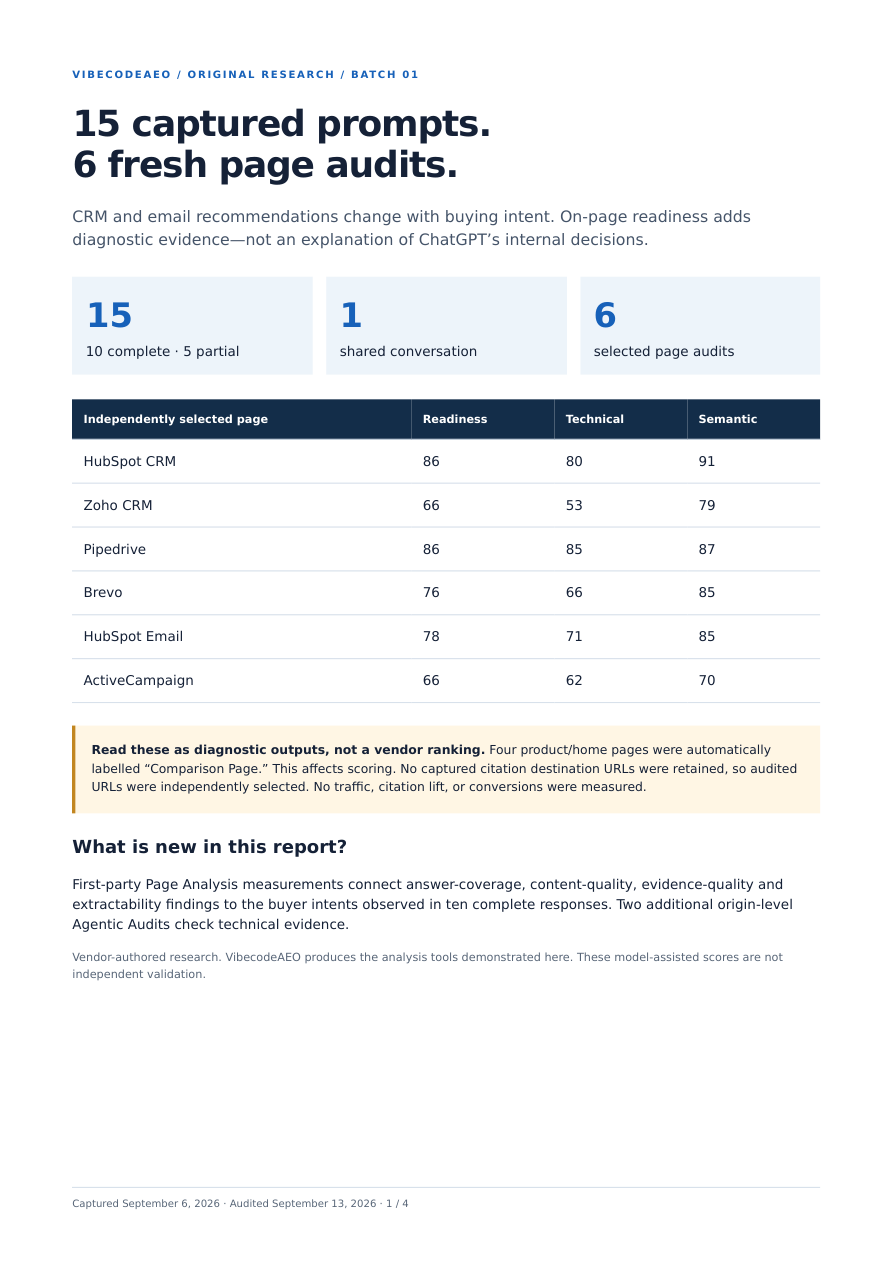
Figure: Rendered four-page evidence summary covering the selected page audits, numeric readings, and limitations. It is an artifact of this vendor-authored research, not the full article, and does not turn readiness outputs into independent rankings.
Download the full CRM/email batch research PDF.