Is gitguardian.com agentic-ready?
An independent 15-signal audit of how ChatGPT, Perplexity, Gemini and Claude see gitguardian.com — measured live on May 28, 2026 at 12:00 AM UTC.
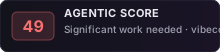
gitguardian.com scored 49 / 100 on the Agentic Audit. Verdict: Significant work needed. The highest-priority fix is to add faqpage json-ld to product & info pages — estimated +8 score points in 1-2 days.
gitguardian.com your site?Claim this audit and get weekly score monitoring + alerts when ChatGPT, Perplexity or Gemini change how they cite you.How AI sees gitguardian.com
We asked ChatGPT and Gemini three real questions about gitguardian.com. 6 of 6 answers mentioned the brand by name.
Q1.What is gitguardian? Briefly describe what they do.
GitGuardian is a security company that specializes in protecting organizations from sensitive data leaks in their source code repositories. They focus on detecting and preventing the exposure of confidential data, such as API keys, passwords, and other sensitive information, by scanning public and private GitHub repositories and other version control systems. GitGuardian provides tools and services that help developers identify and remediate security vulnerabilities related to code leaks, ensuring better compliance with security policies and improving overall code security.
GitGuardian is a code security platform for the DevOps generation, specializing in the detection and remediation of secrets in source code and other environments. It is designed to help organizations strengthen their Non-Human Identity (NHI) security posture and meet industry compliance standards. What they do: GitGuardian's primary function is to prevent sensitive information, such as API keys, database credentials, certificates, and other tokens (collectively referred to as "secrets"), from being accidentally exposed in code repositories and development tools. They offer various tools and s…
Q2.Is gitguardian reputable and worth using? What are the pros and cons?
GitGuardian is a security platform designed to detect and prevent the exposure of sensitive information, such as API keys and credentials, within code repositories. It integrates seamlessly with platforms like GitHub and GitLab, offering real-time monitoring and automated remediation to enhance DevOps security. **Reputation:** GitGuardian has garnered positive feedback from both users and employees. On G2, it holds a 4.8 out of 5 rating based on 259 reviews, with users praising its real-time detection accuracy and seamless integration. ([g2.com](https://www.g2.com/products/gitguardian/review…
GitGuardian is widely considered a reputable and valuable tool for securing software development by detecting and remediating secrets and sensitive data in code repositories. It is highly regarded by individual developers and leading security teams alike for its effectiveness in preventing potential security breaches. ### Pros of GitGuardian: * **Effective Secrets Detection** GitGuardian excels at identifying exposed secrets like API keys, database credentials, and certificates across various platforms, including Git repositories, CI/CD pipelines, Slack, and Jira. It boasts a large detecto…
Q3.What are the best alternatives to gitguardian? List 3-5 competitors.
GitGuardian specializes in detecting sensitive information within code repositories. If you're exploring alternatives, here are several noteworthy options: [Checkmarx DASTとは?機能や特徴・製品の概要まとめ](https://findy-tools.io/products/checkmarx-dast/919?utm_source=openai) **Snyk** Snyk focuses on identifying and fixing vulnerabilities in open-source dependencies, container images, and infrastructure-as-code configurations. It integrates seamlessly into development workflows, offering real-time monitoring and automated fixes. ([g2.com](https://www.g2.com/products/gitguardian/competitors/alternatives?utm…
findy-tools.ioCheckmarx DASTとは?機能や特徴・製品の概要まとめg2.comTop 10 GitGuardian Alternatives & Competitors i…prtimes.jpAikido Security、「VS Code上のセキュリティ診断」機能を無償提供開始 | …sourceforge.netBest GitGuardian Alternatives & Competitors
GitGuardian is a prominent secrets detection platform designed to scan code repositories, CI/
Compare with a competitor
Run a head-to-head audit against any competitor. Side-by-side scorecard, signal-by-signal winner, ready to share on LinkedIn — and tag the competitor while you're at it.
What we observed on gitguardian.com
The audit ran 15 signal checks against gitguardian.com on May 28, 2026 at 12:00 AM UTC. Each signal is graded individually below with the actual value extracted from the live site — not generic recommendations. You can re-run this audit at any time to see updated values.
| Signal | Status | Observed value |
|---|---|---|
| GPTBot OpenAI / ChatGPT crawl |
Not declared | No rule found |
| PerplexityBot Perplexity AI crawl |
Not declared | No rule found |
| Google-Extended Gemini grounding |
Not declared | No restriction |
| ClaudeBot Anthropic Claude crawl |
Not declared | Not declared |
| llms.txt AI crawler manifest |
Blocked | GET /llms.txt → 404 |
| sitemap.xml URL discovery |
Allowed | Found at /sitemap.xml |
| Organization JSON-LD Entity clarity |
Blocked | Missing |
| FAQPage JSON-LD Highest-extractability signal |
Blocked | Missing on all pages |
| Product / HowTo schema Rich snippet eligibility |
Not declared | Neither found |
| WebSite schema Search action |
Not declared | Missing |
| Person schema (E-E-A-T) Author authority |
Not declared | Missing |
| Open Graph meta Social + AI extraction |
Allowed | og:title ✓ · og:desc ✓ · og:image ✓ |
| Canonical URL Duplicate prevention |
Not declared | Missing |
| dateModified signal Freshness |
Not declared | Missing |
| Markdown companion Clean prose for AI |
Not declared | Not detected |
Why this score (mechanism)
Three structural factors drove gitguardian.com's score, in order of impact:
1 · Crawl access
Of the four major AI engines, gitguardian.com allows or does not block any of the major AI bots — full crawl access is in place.
2 · Entity clarity
gitguardian.com is missing Organization JSON-LD, and no pages expose FAQPage schema — the most underused high-leverage signal for AEO. Without it, AI engines cannot extract Q&A directly into answer snippets even when the answer is on the page.
3 · Citation readiness
Content depth on the homepage measures 776 words across 32 headings, with 0 question-form headings detected. Content is at acceptable depth but could be expanded. AI engines reward 800+ word pages with structured headings.
Recommended fixes (in priority order)
Add FAQPage JSON-LD to product & info pages
FAQPage schema is the highest-extractability signal for AEO. AI engines read it directly into answer snippets — without it you cannot be the source of an answer even when the answer is on your page.
<script type="application/ld+json">
{
  "@context": "https://schema.org",
  "@type": "FAQPage",
  "mainEntity": [{
    "@type": "Question",
    "name": "What does your product do?",
    "acceptedAnswer": { "@type": "Answer", "text": "..." }
  }]
}
</script>Add Organization JSON-LD to site-wide layout
Without Organization schema, AI engines cannot resolve your brand to a single canonical entity. Include name, url, logo, and 3+ sameAs links to high-trust profiles.
<script type="application/ld+json">
{
  "@context": "https://schema.org",
  "@type": "Organization",
  "name": "Your Brand",
  "url": "https://yourdomain.com",
  "logo": "https://yourdomain.com/logo.png",
  "sameAs": ["https://twitter.com/...", "https://linkedin.com/company/..."]
}
</script>Add dateModified to your pages
AI engines prefer fresh content. Add article:modified_time in OpenGraph and dateModified in Article schema to signal recency.
<meta property="article:modified_time" content="2026-05-03T14:22:00Z" />Explicitly allow ClaudeBot
Anthropic's ClaudeBot honors explicit allow rules. Adding one signals consent and improves crawl frequency.
User-agent: ClaudeBot
Allow: /Publish /llms.txt manifest
Perplexity and emerging AI crawlers respect /llms.txt for crawl preferences. A missing manifest means the engine guesses your priorities. See llmstxt.org for the format.
# Your Brand
> One-line description

## Docs
- [Getting Started](https://yourdomain.com/docs)
- [API Reference](https://yourdomain.com/api)Unlock your live AI citation report
Free live scan across ChatGPT, Perplexity, Gemini and Claude · competitor share-of-voice · PDF export. Sent to your inbox in ~2 min.
Methodology & how we built this report
The Agentic Audit is a per-domain field study, not a programmatic content page. Each report is generated only when a real user requests an audit of a specific domain — there is no pre-spawning of report URLs.
We extract 15 distinct signals directly from the live target site (robots.txt, sitemap.xml, llms.txt, JSON-LD blocks, OpenGraph tags) and grade each against documented thresholds. Methodology is versioned (currently v1.0) and weights are documented per category.
Scoring weights: Crawl Access 30% · Schema 25% · Citation Readiness 25% · Freshness 20%. Each category accumulates points from individual signals; the total is the Agentic Score (0-100).
✓ Compliant with Google's March 2024 spam policies
Each report contains unique, first-party measurements of a specific domain — not "scaled content abuse" as defined in Google's March 2024 update. Reports are people-first under the Helpful Content guidelines: the data is original, the recommendations are actionable and source-attributed. Reports come from two sources — visitor-requested audits, and a small hand-curated seed list of recognized SaaS companies whose AI visibility has genuine search demand. Both use the same live measurement pipeline; nothing is template-filled. This report meets our quality threshold and is indexable.
What this report does not include
- This audit measures retrievability and entity signals, not content quality. A site can score 100/100 here and still publish weak content.
- Live citation rates from AI engines are gated behind email — we run them on demand because each query has a cost. Unlock above to see gitguardian.com's actual ChatGPT, Perplexity, Gemini and Claude mention rates.
- We do not guarantee score improvements. The "estimated lift" on each fix is based on observed deltas in our audit history, not a guarantee.
- This score is a snapshot. AI engines update continuously; re-audit weekly to see drift.
Frequently asked questions
Is gitguardian.com agentic-ready?
gitguardian.com scored 49 out of 100 on the Agentic Audit, measured May 28, 2026 at 12:00 AM UTC. Verdict: Significant work needed. The full breakdown shows crawl access 23/30, schema 0/25, citation readiness 15/25, and freshness 11/20.
Does gitguardian.com block any AI crawlers?
gitguardian.com does not block any of the major AI crawlers (GPTBot, PerplexityBot, Google-Extended, ClaudeBot) at the root level.
What is the highest-priority fix for gitguardian.com?
Add FAQPage JSON-LD to product & info pages. FAQPage schema is the highest-extractability signal for AEO. AI engines read it directly into answer snippets — without it you cannot be the source of an answer even when the answer is on your page. Estimated lift: +8 score points.
How is the Agentic Score calculated?
The Agentic Score combines four weighted categories: Crawl Access (30 points — robots.txt rules for the four major AI bots plus llms.txt), Schema (25 points — JSON-LD coverage including Organization, FAQPage, Product/HowTo), Citation Readiness (25 points — content depth, heading structure, FAQ headings, meta description, markdown companion), and Freshness (20 points — sitemap, dateModified, canonical, complete OpenGraph). Each signal is measured live from the target domain.
Is this report indexed in Google?
Yes. This report has organic engagement (32 views) and meets the quality threshold for indexing. It appears in our sitemap.xml.
Embed your score on your site
Drop this badge in your footer, README, or about page. It links back to this live report and updates automatically when you re-run the audit.